
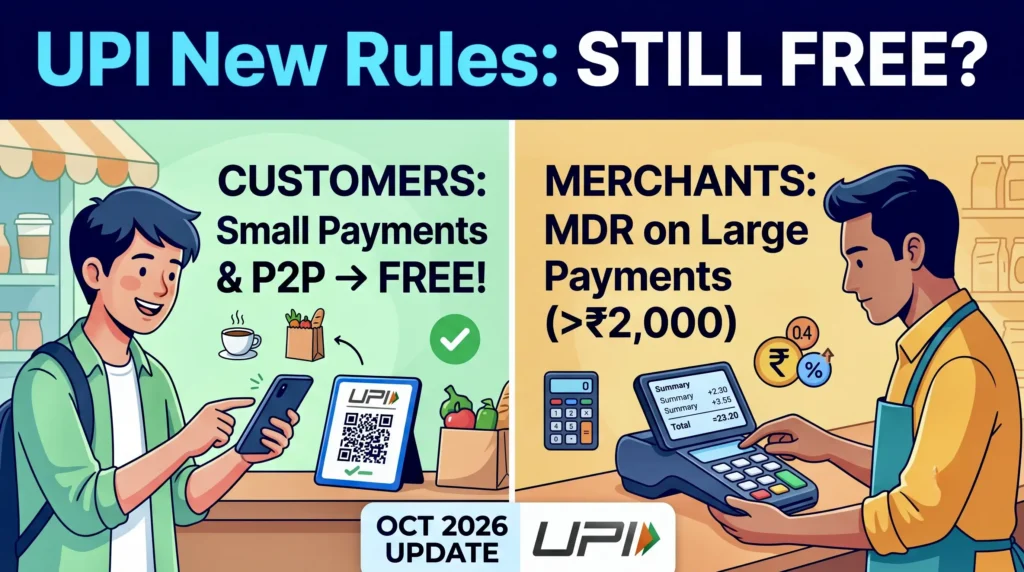
If you’ve been scrolling through news or WhatsApp forwards lately, you’ve probably seen some version of “UPI is no longer free!” Take a breath — that’s not quite true. Here’s the real story on the UPI MDR latest update, explained without the jargon.
What Is MDR in UPI?
Let’s use a simple example. Say you buy a phone case from a shop and pay ₹10,000 using UPI.
- You are the customer.
- The shopkeeper is the merchant.
- This is called a P2M transaction — Person to Merchant.
- MDR (Merchant Discount Rate) is a small fee the merchant pays to the banks and companies that process the payment — for the tech, security, and infrastructure that made that instant transfer possible.
- The merchant bears this cost, not you.
- Your ₹10,000 goes through in full. You are never charged extra.
- If MDR applied here (0.4% on transactions above ₹2,000), it would be ₹40 — paid by the shopkeeper to the payment ecosystem, deducted from what the shop receives.
So MDR is simply the “cost of doing business” digitally — like the fee a shop already pays when someone swipes a credit card.
Is UPI Still Free for Customers?
Yes. Completely. Person-to-Person (P2P) transfers — sending money to family, friends, or splitting a bill — remain 100% free, no matter the amount. This latest change only touches certain merchant-side payments above ₹2,000.
What Has Changed in the Latest UPI MDR Framework?
NPCI announced a new framework on September 15, 2026, effective October 15, 2026:
- Standard P2M UPI transactions above ₹2,000 attract 0.4% MDR, capped at ₹300 for transactions of ₹75,000 and above.
- Transactions up to ₹2,000 stay at zero MDR.
- Essential sectors — railways, telecom, insurance, fuel, agricultural inputs — get a flat ₹5 MDR on payments above ₹2,000.
- Capital market transactions (mutual funds, stockbroking) attract a lower 0.02%, capped at ₹300.
- Small merchants under the P2PM category, receiving up to ₹1 lakh/month via UPI QR, stay at zero MDR.
This ends the zero-MDR regime that had been in place since January 2020.
UPI MDR Rules Explained With Simple Examples
- You send ₹50,000 to a friend → P2P, always free → No MDR, no impact on either side.
- You buy groceries for ₹1,500 → P2M, under ₹2,000 → Zero MDR → You pay ₹1,500, shop gets ₹1,500.
- You pay ₹5,000 at an eligible large merchant → 0.4% MDR = ₹20 → You still pay ₹5,000; merchant receives ₹4,980.
- A merchant receives ₹80,000 in one transaction → Above ₹75,000, so the ₹300 cap applies instead of ₹320 (0.4%) → Merchant pays ₹300, not more.
- A street vendor under P2PM (earning under ₹1 lakh/month) → Zero MDR, regardless of individual transaction size.
- You pay a ₹4,000 electricity bill → Essential sector → Flat ₹5 MDR, paid by the biller, not you.
Who Pays MDR — Customer or Merchant?
The merchant. Always. The Ministry of Finance has explicitly stated that banks must ensure merchants don’t pass this cost to customers, and UPI app providers are barred from adding any platform fee. Doing so would be illegal.
What Happens to UPI Payments Below and Above ₹2,000?
| Transaction Type | Amount/Condition | MDR | Customer Pays? | Merchant Faces MDR? |
|---|---|---|---|---|
| P2P (any amount) | Any | 0% | No | No |
| P2M | Up to ₹2,000 | 0% | No | No |
| P2M (standard) | Above ₹2,000 | 0.4% (max ₹300) | No | Yes |
| Essential sectors | Above ₹2,000 | Flat ₹5 | No | Yes |
| Capital markets | Above ₹2,000 | 0.02% (max ₹300) | No | Yes |
| Small merchant (P2PM, ≤₹1L/month) | Any | 0% | No | No |
Special Rules for Small Merchants
If you’re a small vendor receiving up to ₹1 lakh a month through UPI QR, nothing changes for you — zero MDR continues. This protects roadside vendors, kirana stores, and small sellers. The government says this shields 96% of merchant transactions from any new charge. A dedicated fund, fed by 5% of total MDR collections, will also support UPI expansion for small and rural merchants.
Sector-Specific MDR Rules
Railways, telecom, insurance, fuel, and agri-input payments get a lighter flat ₹5 fee instead of a percentage — because these are thin-margin, high-volume essential services.
5 Common Myths About UPI MDR
- “Every UPI payment will now cost extra.” False — P2P and payments under ₹2,000 stay free.
- “There’s a new UPI tax.” False — MDR is an ecosystem fee, not a government tax.
- “Customers above ₹2,000 pay extra.” False — merchants bear it; passing it on is illegal.
- “Small shops automatically lose money.” False — most qualify for zero MDR under P2PM.
- “Daily UPI limits are MDR thresholds.” False — transaction limits (₹1L–₹5L) are security limits, unrelated to MDR.
What the New Rules Mean for Customers
Nothing changes for you. Keep paying via UPI as usual — free for P2P and small payments.
What the New Rules Mean for Merchants
Check if you fall under the ₹1 lakh/month P2PM exemption. If you’re a larger merchant, understand which category your sector falls into and speak with your payment aggregator.
UPI MDR Explained in One Minute
MDR is a merchant-side fee (0.4%, capped at ₹300) on P2M UPI payments above ₹2,000, starting October 15, 2026. P2P stays free forever. Small merchants and low-value payments stay exempt. Customers never pay it.
Final Takeaway
The UPI MDR latest update doesn’t end free UPI — it introduces a targeted, small fee on a narrow slice of larger merchant transactions, while protecting everyday users and small businesses. Understanding the difference between P2P and P2M is the key to cutting through the confusion.
- Your ‘Backup’ Account Could Be Frozen This Month: The 1-Minute Move to Prevent a Banking Lockout
 Dormant bank accounts expose you to fraud, identity theft, and financial loss. Discover how to keep your account active, prevent dormancy risks, reactivate frozen accounts, and protect your money from unauthorized access with RBI-compliant strategies.
 - Why a Tiny $2.00 Bank Charge Could Be Your Biggest Warning SignReviewing your bank statements regularly and reporting lost cards immediately are your most powerful weapons against fraud. When you catch unauthorized transactions early, you’re already ahead of most fraudsters. Consumer fraud losses exceeded $12.5 billion in 2024, making vigilant account monitoring essential for protecting your financial security.
- What is HUF? The Ancient Rule Letting Modern Families Unlock Double Tax Benefits
 Want to legally save on income tax? Discover how a Hindu Undivided Family (HUF) protects wealth and maximizes tax benefits. Explore our complete guide on HUF eligibility, the 2005 amendment, and step-by-step instructions to open an HUF bank account.
 - UPI MDR 2026: Is UPI Still Free? Here’s the Real Answer
 A simple guide to the new UPI MDR rules effective October 15, 2026 — who pays the 0.4% merchant charge, who doesn’t, and why UPI stays free for customers.
 - Union Bank, BOI, and IOB: The Next Mega-Merger Wave is Coming. Here’s How Your Savings & Account Details Will Change
 India’s public sector banking faces a transformative merger wave. Finance Minister Sitharaman confirmed talks with RBI on consolidating 12 banks into six to seven globally competitive institutions. Expected announcements in April-May 2026 will reshape banking operations, employee roles, and customer services fundamentally.