
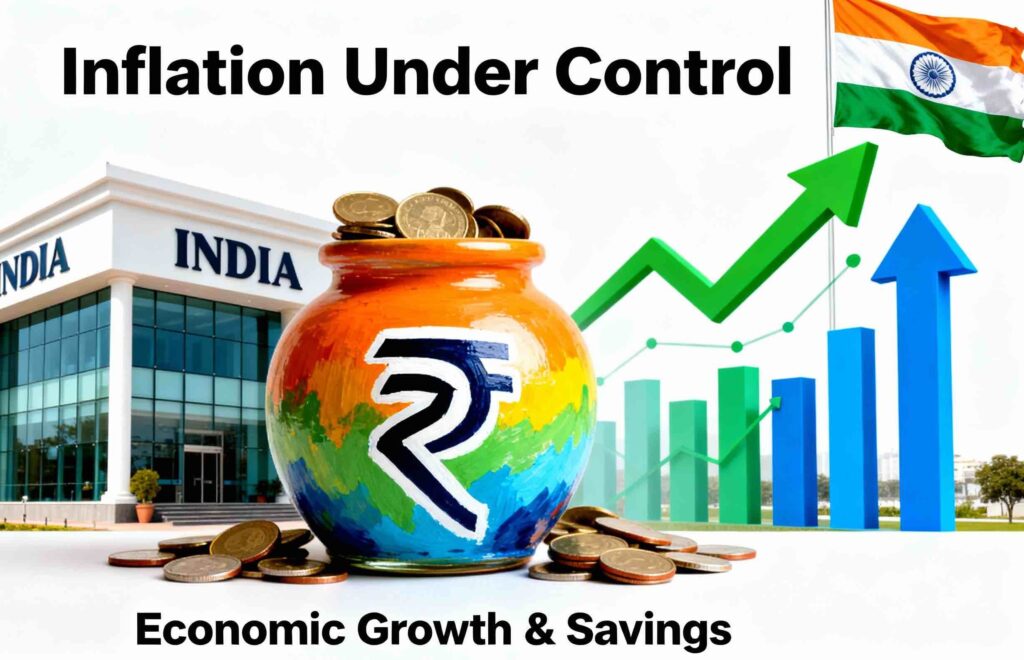
The Reserve Bank of India (RBI) has cut the repo rate by 25 basis points to 5.25%, aiming to support economic growth while keeping inflation under control. This move by the Monetary Policy Committee (MPC) comes at a time when India is witnessing healthy GDP growth, moderate inflation and comfortable liquidity in the banking system. For the common citizen, this decision directly affects home loan EMIs, personal loans, business borrowing costs, deposit rates, and overall economic confidence.
What Is The Repo Rate And Why Is It Important?
The repo rate is the interest rate at which the RBI lends short-term funds to commercial banksagainst government securities. It is the primary policy rate used by the central bank to signal the stance of monetary policy and influence overall interest rates in the economy.
When the RBI cuts the repo rate:
- Borrowing for banks becomes cheaper.
- Over time, banks are expected to reduce lending rates on loans.
- This lowers EMIs for retail and business borrowers.
- It encourages consumption and investment, supporting economic growth.
When the RBI hikes the repo rate, the opposite happens: loans become costlier, demand slows, and inflation is cooled down.
Why Has RBI Cut The Repo Rate By 25 Basis Points Now?
The MPC has decided to reduce the policy repo rate from 5.50% to 5.25%, a cut of 25 basis points (0.25 percentage points). This move marks a cumulative reduction of about 125 basis points in 2025, signalling a clear shift towards growth support while retaining a neutral policy stance.
Key reasons behind this rate cut:
- Inflation is well under control
- Headline and core inflation are projected to remain close to the 4% target in the coming quarters.
- The RBI has reduced its inflation forecast for the current year to around 2%, thanks to easing food prices and benign cost pressures.
- With inflation comfortably below the upper tolerance band, the RBI has “policy space” to support growth.
- Strong GDP growth and “Goldilocks” conditions
- Real GDP growth has been robust, with recent quarterly growth around 8%, supported by healthy consumption and investment.
- The RBI Governor has described the current environment as a “rare Goldilocks period” – strong growth with low inflation and adequate liquidity.
- Growth forecast for the year has been revised upwards to about 7.3%, indicating confidence in the underlying momentum of the Indian economy.
- Comfortable liquidity and stable financial system
- Global backdrop and external risks
- While many advanced economies still face above-target inflation and tighter monetary policy, several emerging markets, including India, now have room to be growth-supportive.
- At the same time, the RBI remains cautious about geopolitical uncertainty, trade tensions, capital flows and rupee volatility.
In short, the rate cut to 5.25% reflects a balanced approach: supporting growth without compromising on inflation control or financial stability.
How Will The Repo Rate Cut Affect Your Loans And EMIs?
One of the most immediate questions for households is: Will my EMI go down?
The answer is: Yes, gradually, especially if your loan is linked to a floating rate (external benchmark or repo-linked rate).
- Home loans
- Most new home loans today are linked either to the repo rate or other external benchmarks.
- As banks’ cost of borrowing falls, they are expected to pass on the benefit by cutting RLLR (Repo Linked Lending Rate) and other benchmark-linked rates.
- Over the coming weeks and months, borrowers may see lower EMIs or shorter loan tenors, depending on their loan structure and bank’s policy.
- Personal loans, car loans and consumer credit
- Rate cuts tend to make personal loans and vehicle loans more affordable over time, particularly those on floating rates.
- For credit card users, the impact is less direct because card rates are usually much higher and not tightly linked to the repo rate, but competitive pressures can still encourage lenders to offer better terms.
- Business loans and working capital finance
However, the transmission from repo rate to actual loan rates is not instantaneous. It depends on:
- How quickly banks adjust their benchmark rates.
- The spread they charge over repo or external benchmarks.
- The type of loan (fixed vs floating, old vs new loans).
Impact On Fixed Deposits And Savers
While borrowers generally welcome a repo rate cut, savers and depositors may be worried about lower interest on fixed deposits (FDs) and other savings products.
- Banks, facing lower lending rates, typically also reduce deposit rates over time to protect their margins.
- This means future FD offerings may come with slightly lower interest rates than before the rate cut.
- For senior citizens and conservative investors, it becomes even more important to compare bank FD rates, consider laddering deposits, and explore diversified debt instruments based on risk profile and liquidity needs.
At the same time, stable low inflation means that even with somewhat lower nominal deposit rates, the real rate of return (interest minus inflation) can remain reasonable.
How Does This Rate Cut Support Economic Growth?
The RBI’s decision to cut the repo rate to 5.25% is part of a broader strategy to nurture growthwhile preserving macroeconomic stability.
The growth-supportive channels include:
- Cheaper borrowing costs for households and businesses, encouraging consumption and investment in housing, vehicles, consumer durables and capital goods.
- Improved cash flows for existing borrowers as EMIs ease, leaving more disposable income for spending.
- Increased credit demand, particularly from sectors like real estate, infrastructure, manufacturing and services.
- Support to rural consumption, which has already been improving on the back of better agricultural prospects and tax rationalisation.
With inflation projected to remain around the 4% target, RBI can allow interest rates to be relatively low without risking runaway price increases.
Inflation Under Control: Why That Matters For You
The RBI’s primary mandate is to keep inflation around 4% with a tolerance band. Cutting rates at the wrong time—when inflation is high—can worsen price pressures. In this case, however:
- Consumer price inflation has eased noticeably compared to earlier peaks.
- Wholesale inflation has moderated due to softer commodity and food prices.
- The RBI has revised inflation forecasts downward, reflecting confidence that price pressures are subdued and well-anchored.
For ordinary citizens, low and stable inflation means:
- Everyday expenses like food, fuel, transport and utilities rise more slowly.
- Savings do not lose value rapidly in real terms.
- Businesses can plan better, as input costs are more predictable.
This creates a virtuous cycle where price stability allows lower interest rates, which in turn support growth and employment.
RBI’s Neutral Stance: What It Signals About Future Rates
Despite cutting the repo rate, the MPC has chosen to maintain a neutral stance, rather than explicitly shifting to an “accommodative” one.
A neutral monetary policy stance means:
- The RBI is not pre-committing to either continued rate cuts or immediate rate hikes.
- Future actions will depend on incoming data on inflation, growth, global conditions, financial stability and liquidity.
- The central bank wants to remain flexible and data-driven, ready to adjust policy as needed.
For markets and the public, this implies:
- There may be room for further easing if inflation stays low and growth needs more support.
- Conversely, if inflation flares up or external risks intensify, the RBI may pause or reverse rate cuts.
This balanced approach reassures both borrowers, who welcome lower rates, and investors and savers, who care about inflation and currency stability.
Impact On Rupee, Bond Markets And Stock Markets
Monetary policy decisions also affect financial markets, which in turn influence investment returns and economic sentiment.
- Government bond yields
- Rupee exchange rate
- Equity markets
- Stock indices such as Nifty and Sensex reacted positively but modestly to the rate cut, reflecting a balance of growth optimism and global uncertainty.
- Sectors that tend to benefit from lower rates—such as banks, NBFCs, real estate, autos and consumer discretionary—generally gain when borrowing costs fall.
What Should Borrowers And Investors Do Now?
For borrowers:
- Review whether your existing loans are linked to repo or external benchmarks. If not, consider speaking to your bank about switching or refinancing if it is cost-effective.
- Monitor announcements from your bank regarding rate cuts in home, personal and business loans in the coming weeks.
- Use any EMI savings wisely—either to prepay loans faster or to build emergency savings.
For savers and investors:
- Expect gradual adjustment in FD and recurring deposit rates.
- Do not chase yield blindly; balance safety, liquidity and returns.
- Consider diversifying across bank deposits, high-quality debt funds, and other low-risk instruments depending on risk appetite and time horizon.
For small businesses and entrepreneurs:
- Assess whether lower borrowing costs can support expansion, technology upgrades or working capital needs.
- Maintain healthy credit behaviour to benefit from better loan terms as banks compete for quality borrowers.
- HDFC Bank Q3 Surprise: Profit Jumps 11.5% – Why Experts Call It a ‘Screaming Buy’ at ₹930
 HDFC Bank’s Q3 FY26 results shine: 11.5% profit surge to ₹18,653 Cr, GNPA at 1.24%, deposits up 11.5%. Beats estimates amid deposit wars—strong buy for 2026? Stock eyes ₹1,000 breakout.
 - Withdraw PF Money in Seconds? EPFO’s New UPI Update is the Game-Changer
 Discover EPFO UPI withdrawal: Instant PF access in minutes via PhonePe or Google Pay. Step-by-step guide, eligibility, benefits, and tax rules for 2026. Skip delays—empower your savings today!
 - The Truth Behind the “TCS Employee Salary Drop”: Viral News, Variable Pay and What It Means for You
 Discover the real reasons behind the viral TCS employee salary drop. From variable pay cuts to strict WFO mandates and performance bands, learn why IT take-home pay is shrinking and how to protect your earnings effectively.
 - Stop! Don’t “Liquidate” Your ₹500 Notes Yet: What the New RBI Circular Actually Says
 GOI debunks viral ₹500 note discontinuation rumor. Fake news claimed RBI would ban notes by March 2026. Official clarification: ₹500 notes remain legal tender, ATMs continue dispensing them. Learn how to spot fake currency news and verify financial information.
 - Cheques are Making a Huge Comeback in India—and They’re Now as Fast as UPI!
 India’s real-time cheque clearing system launched October 2025, processing cheques in hours instead of days. While Phase 2 was postponed, Phase 1 delivers same-day clearing with auto-approval features. Learn how continuous clearing speeds up banking for businesses and freelancers.
 - Planning a Gold Loan in 2026? This New RBI Rule Could Slash Your Cash by Thousands Overnight
 April 2026 brings RBI’s new gold loan regulations with tiered LTV limits: 85% for loans under ₹2.5 lakh, 80% for ₹2.5–5 lakh, and 75% above. Understand how these rules impact your borrowing capacity and protect your precious ornaments.
 - Stop Paying Your Bank! RBI’s New Zero-Balance Rules Could Save You Over ₹5,000 Every Year
 Your bank account shouldn’t drain your pocket. Millions of Indians lose ₹5,000+ yearly to hidden charges and penalties. The RBI’s revised zero-balance account rules—effective April 2026—eliminate these fees entirely. Discover how to save thousands while maintaining complete banking access.
 - Why Your Old Chequebook Might Stop Working: Understanding India’s Bold Bank Consolidation
 Explore India’s ambitious PSU bank consolidation strategy reshaping the financial sector. Understand recent mergers, the government’s FY27 mega plan, and how bank consolidation impacts customers, employees, and the broader banking ecosystem.
 - Big Relief for Businesses: RBI Relaxes Current Account Norms; Major Changes Effective April 2026
 The RBI’s December 2025 amendments fundamentally reshape business financing by removing restrictions on cash credit accounts and raising current account thresholds to Rs 10 crore. These relaxations in current and cash credit norms enhance working capital accessibility, enabling businesses to optimize liquidity management and reduce operational financing costs significantly.
 - One Rule for All: How RBI’s Standardized Minimum Balance Will Change Your Banking in 2026
 The Reserve Bank of India’s updated minimum balance framework, effective December 10, 2025, reduces penalties to ₹200 maximum and introduces flexible thresholds. Urban savings accounts require ₹500 minimum, rural accounts ₹200, while zero balance BSBD accounts eliminate requirements entirely, promoting financial inclusion across India’s banking sector.
Pingback: Debt Consolidation Strategy: Merge Multiple EMIs Into One