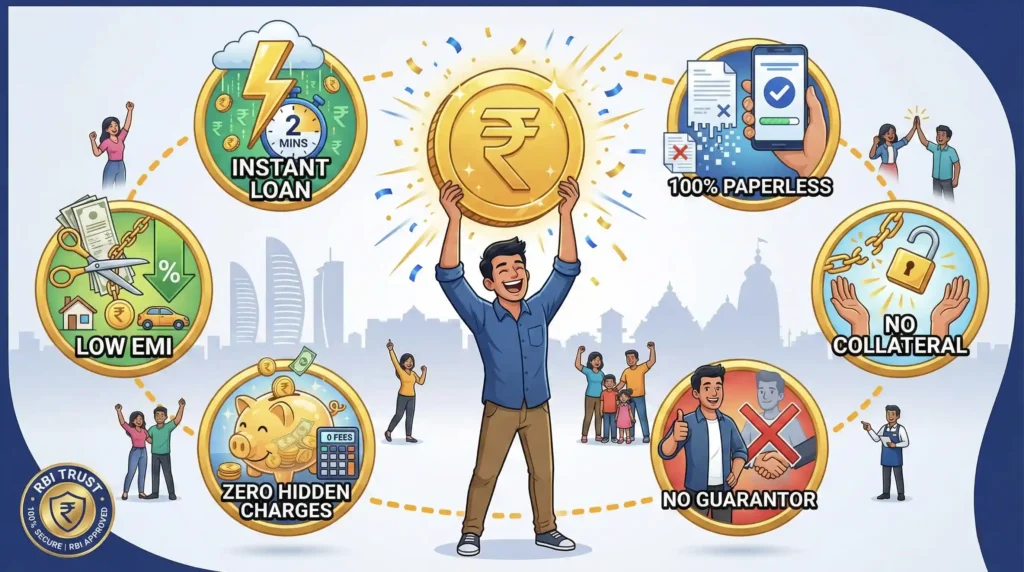

Attractive Interest Rate
3 Unique Variants
Loan of upto Rs.40 Lakhs
Tenure of upto 84 months
No Guarantor/ Collateral
No Hidden Charge
Key Features & Benefits of Our Personal Loan
Loan Amounts: Up to ₹40 Lakhs, tailored to your needs.
Flexible Tenures: Repay over 12 to 84 months at EMIs you can afford.
No Collateral or Guarantors: Unsecured loans for quick access.
Instant Disbursement: Funds in your account within 24-48 hours of approval.
Minimal Documentation: Apply with basic personal loan documents like Aadhaar and PAN.
Competitive Rates: Starting from 10.5% p.a. for best personal loan in India options.
Ways to Use a Personal Loan
Personal loans offer unmatched flexibility. Here’s how Indians commonly use them:
- Debt Consolidation: Combine high-interest debts into one low-interest personal loan to save on EMIs.
- Weddings: Fund dream ceremonies without dipping into savings.
- Medical Emergencies: Cover unexpected hospital bills swiftly.
- Home Renovation: Upgrade your space with easy financing.
- Education or Travel: Support higher studies or family vacations.
- Business Boost: Salaried individuals can expand side hustles.
| Category | Salaried Individuals | Self-Employed Individuals |
|---|---|---|
| Age | 21-60 years (at loan maturity) | 23-65 years |
| Monthly Income | ₹15,000-₹25,000/month (metros); ₹20,000-₹30,000 (Tier 2 cities) | ₹25,000-₹40,000/month or ₹15 lakh ITR annually |
| Credit Score | 750+ ideal; 650+ viable | 750+ ideal; 685+ minimum |
| Employment | 1-2 years total; 6-12 months current job | 3+ years business vintage |
| Citizenship | Indian Resident | Indian Resident |
Keep these ready for a seamless instant personal loan online application:
KYC Documents
Identity Proof (Aadhaar/ Voter ID/ Passport/ Driving License)
PAN Card
Passport-sized photo
Address proof (Utility bills/ rental agreement/ property documents)
Income Proof
Salaried: Last 3 months’ salary slips and bank statements
Self-Employed: ITR (last 2 years), profit/loss statements and 6-12 months’ bank statements
✕
Calculator Information
The Equipment Finance Calculator calculates the type of repayment required, at the frequency requested, in respect of the loan parameters entered, namely amount, term and interest rate. The Product selected determines the default interest rate for personal loan product. The Equipment Finance Calculator also calculates the time saved to pay off the loan and the amount of interest saved based on an additional input from the customer. This is if repayments are increased by the entered amount of extra contribution per repayment period. This feature is only enabled for the products that support an extra repayment. The calculations are done at the repayment frequency entered, in respect of the original loan parameters entered, namely amount, annual interest rate and term in years.
Calculator Assumptions
Length of Month
All months are assumed to be of equal length. In reality, many loans accrue on a daily basis leading to a varying number of days interest dependent on the number of days in the particular month.
Number of Weeks or Fortnights in a Year
One year is assumed to contain exactly 52 weeks or 26 fortnights. This implicitly assumes that a year has 364 days rather than the actual 365 or 366.
Rounding of Amount of Each Repayment
In practice, repayments are rounded to at least the nearer cent. However the calculator uses the unrounded repayment to derive the amount of interest payable at points along the graph and in total over the full term of the loan. This assumption allows for a smooth graph and equal repayment amounts. Note that the final repayment after the increase in repayment amount.
Rounding of Time Saved
The time saved is presented as a number of years and months, fortnights or weeks, based on the repayment frequency selected. It assumes the potential partial last repayment when calculating the savings.
Amount of Interest Saved
This amount can only be approximated from the amount of time saved and based on the original loan details.
Calculator Disclaimer
The results from this calculator should be used as an indication only. Results do not represent either quotes or pre-qualifications for the product. Individual institutions apply different formulas. Information such as interest rates quoted and default figures used in the assumptions are subject to change.
Feel free to use our Loan Calculator
₹
₹
₹
**Note: For exceeding 120 no. of payments, a group of 12 payments will be combined into a single payment number for better chart visibility.
| Period | Payment | Extra Payment | Interest | Balance |
|---|
Personal Loan FAQs
Is a student eligible for Personal Loan?
Students may apply for personal loans, though eligibility criteria and loan terms vary by lender and the applicant’s financial circumstances. Approval is typically simpler for employed students or those with a stable income source, and a strong credit score enhances approval chances while securing lower interest rates.
Conversely, applicants with limited or no income may need a co-signer—a creditworthy individual who agrees to assume financial responsibility for the loan should the primary borrower default.
Is a pensioner having bank account in any Indian bank eligible for Personal Loan?
Pensioners maintaining a pension account with any Indian bank are generally eligible to apply for personal loans, as many banks and financial institutions offer tailored options specifically for retirees. These loans come with unique eligibility criteria, terms, and conditions that differ from standard personal loans—for instance, lenders may enforce age limits or mandate proof of pension income for approval. Before proceeding, pensioners should meticulously review each lender’s eligibility requirements and loan terms while comparing offerings from multiple providers to identify the most suitable option aligned with their financial circumstances.
Can I apply for Personal Loan without salary slip?
Yes, you can apply for a personal loan without salary slips by submitting alternative financial documents to verify your income. Lenders may accept an income certificate from your employer, bank statements reflecting regular credits, Income Tax Returns (ITR), or Form 16 as valid proof. Note that each lender sets specific criteria for document types and volumes, and alternative income sources could influence your eligibility, interest rate, or approved loan amount.
Can I take Personal Loan for my wedding?
Yes, personal loans can be used to cover wedding expenses, as these events often involve significant costs. However, assess your ability to repay the loan first, since defaulting can harm your credit score and long-term financial health.
When applying for a personal loan toward marriage costs, lenders may request a total expense estimate and a breakdown of fund usage. Loan terms—like interest rates and repayment tenure—depend on your credit score, income, and borrowed amount. Always compare offers from multiple lenders to secure the best fit for your finances.
Is security or collateral required for Personal Loan?
Personal loans are unsecured, so they typically do not require collateral or security. Lenders assess approval and interest rates based on the borrower’s creditworthiness, income, and related factors. However, for borrowers with poor credit or high debt-to-income ratios, some lenders may require collateral or a cosigner. In case of default, this collateral or cosigner ensures the lender receives repayment.
How many types of repayment periods available for Personal Loan?
When selecting a personal loan, carefully evaluate the repayment tenure and interest rate, as they significantly influence the overall loan cost. Personal loans offer the following repayment tenure options:
Short-term loans: These span 12 months or less and are intended for quick repayment. They generally carry higher interest rates than longer tenures.
Medium-term loans: These range from 1 to 5 years and suit larger purchases or debt consolidation.
Long-term loans: These extend 5-10 years or more, commonly funding major expenses like homes, cars, or education.
Revolving credit: This provides a credit limit for borrowing and repaying as needed, with interest charged only on the drawn amount and no fixed end date if payments continue.
Payday loans: These are ultra-short-term (a few weeks) for urgent needs but feature very high interest rates.
How to calculate EMI for my Personal Loan?
Here are key steps to calculate your personal loan EMI effectively:
Budget Planning
Determine your EMI amount first, then adjust your budget to ensure timely repayments and avoid defaults.
Loan Tenure
Identify the repayment period, known as the loan tenure, offered by your lender.
Interest Rate
Confirm the applicable interest rate for your personal loan directly with the lender.
EMI Calculator
Use an online EMI calculator—such as Banker Money EMI Calculator—by entering the loan amount, tenure, and interest rate to instantly compute your EMI.
EMI Components
Your EMI comprises principal repayment and interest; early payments favor interest, with the principal share growing over time.
What is the maximum amount can be availed through Personal Loan?
The maximum personal loan amount available in India varies based on factors like your income, credit score, repayment capacity, and the lender’s policies. Lenders generally offer amounts from ₹10,000 up to their specified maximum. Always borrow only what aligns with your eligibility and ensures comfortable repayment.
What is the TAT to process a Personal Loan?
Online personal loan applications via a lender’s website often yield instant approval, with funds disbursed to your account within a few business days. In contrast, in-person applications at a bank or credit union may take several days or weeks, depending on the lender’s internal procedures.
Preparing all required documents in advance and ensuring your application is complete and accurate can significantly speed up processing. Be ready to submit additional supporting documents or information if requested by the lender.
What is the minimum credit score required for a Personal Loan?
Lenders set varying minimum credit score requirements for personal loan approval, based on factors like loan amount, tenure, income, and employment history. Most accept a score of 650 or higher as sufficient for eligibility. However, to secure lower interest rates and better terms, some require 700 or above.
What is the minimum salary required for a Personal Loan?
Eligibility criteria for personal loans vary by lender, but most in India require a minimum monthly salary of ₹15,000. If your income falls below this threshold, you may not qualify from these providers.
If I have a Home Loan, can I still apply for a Personal Loan?
Even if you have an existing home loan, you can apply for a personal loan. Lenders assess your repayment capacity by factoring in your current financial commitments, such as your mortgage. They also evaluate eligibility and loan terms based on your credit score, income, and other relevant factors.
Can I close my loan early, and what will be the charges?
Prepaying a personal loan may incur fees known as prepayment penalties. Certain lenders impose these charges if you repay the loan ahead of the agreed term. The penalty amount differs by lender and may be a fixed fee or a percentage of the outstanding principal. Always review the loan agreement carefully to confirm any prepayment penalties and understand the applicable charges.
Can I negotiate for better interest rate?
Yes, it is possible to negotiate the interest rate on a personal loan. Success depends on factors like your credit score, income stability, and the lender’s policies. To improve your chances, compare rates across lenders, highlight your strong credit profile and financial position, and consider offering collateral for potentially lower rates.
What happens if I fail to repay the Personal Loan?
Defaulting on personal loan payments can severely damage your credit score and overall financial health. Below are the key consequences explained clearly.
Late Fees and Penalties
Missing a payment or paying late triggers charges from the lender. These fees accumulate rapidly, complicating efforts to get back on track with repayments.
Credit Score Damage
Lenders report defaults to credit bureaus, lowering your score significantly. This makes future loans harder to obtain and often leads to higher interest rates and fees.
Legal Action
Persistent defaults may prompt the lender to file a lawsuit, resulting in court judgments or wage garnishment. Such proceedings are expensive and can lead to personal liability.
Collection Calls
Upon default, lenders or collection agencies will contact you repeatedly. These persistent calls create ongoing stress until the debt is resolved.
Collateral Seizure
For secured personal loans backed by assets like a car or property, default allows the lender to repossess the collateral. This results in permanent loss of the asset.