
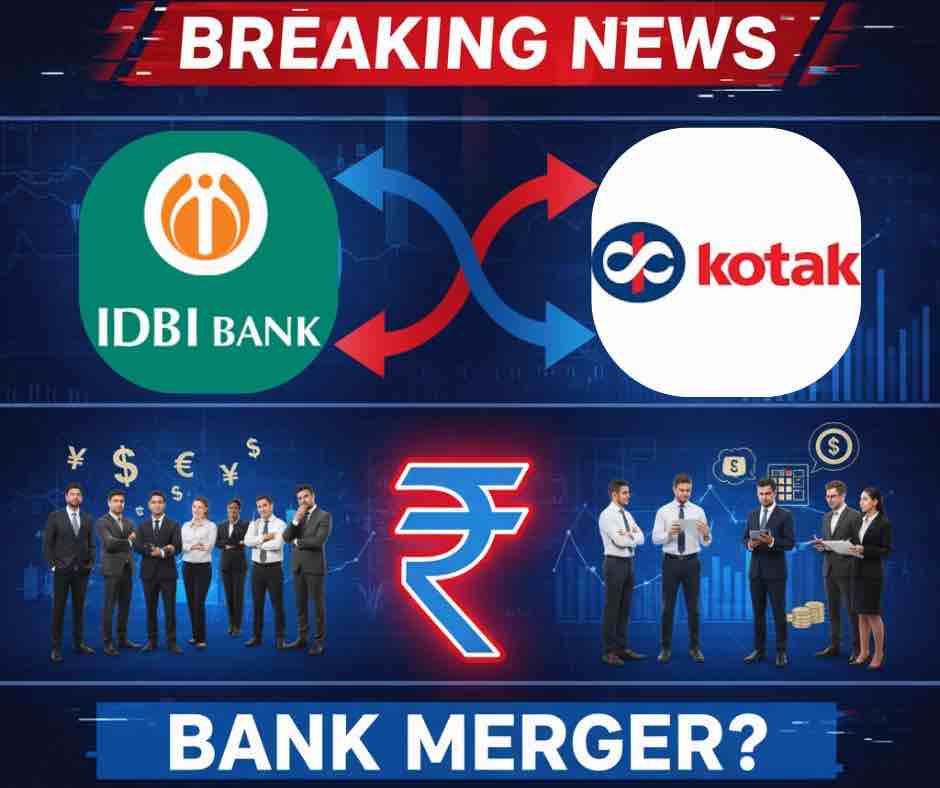
When Kotak Mahindra Bank completed its due diligence for acquiring IDBI Bank in late October 2025, it set the stage for what could be one of India’s most transformative banking deals. If finalized, this acquisition would reshape the country’s financial landscape, directly affecting millions of customers and thousands of bank employees. But as the government prepares to invite final bids by early 2026, a crucial question looms: what does this mega-merger actually mean for the people it will impact most?
The answer is far from simple. While Kotak’s interest in IDBI Bank promises technological upgrades and expanded services for customers, it also brings uncertainty about branch closures, fee changes, and job security for employees transitioning from public to private sector culture.
Where the Deal Stands Today
As of late October 2025, Kotak Mahindra Bank has emerged as the strongest domestic contender for acquiring a controlling 60.72% stake in IDBI Bank, jointly held by the Government of India and Life Insurance Corporation. The bank has concluded its comprehensive due diligence process, examining IDBI’s loan portfolios, borrower data, and asset quality to assess the institution’s true financial health.
This puts Kotak in direct competition with international bidders including Fairfax Financial and Oaktree Capital, though Emirates NBD appears to have exited the race following its recent acquisition of RBL Bank. The government values the stake at approximately $8-10 billion, with final financial bids expected in the coming quarter and a potential deal conclusion by March 2026.
The strategic significance cannot be overstated. If successful, Kotak would inherit IDBI’s network of approximately 1,717 branches across India, instantly expanding from its current footprint of around 1,965 branches. This would create one of the largest private sector branch networks in the country, dramatically accelerating Kotak’s stated ambition to become India’s third-largest private lender.
What Customers Can Expect
For IDBI Bank’s existing customers, Kotak’s acquisition presents a mixed bag of opportunities and challenges. The most immediate positive impact would likely be access to superior digital banking infrastructure. Kotak has invested heavily in technology and mobile banking platforms, offering services that could significantly enhance the banking experience for IDBI customers who have historically dealt with more dated systems.
Customers could gain access to Kotak’s broader product suite, including advanced wealth management services, more competitive loan products, and sophisticated credit card offerings. The private bank’s reputation for customer service and digital innovation suggests that IDBI customers might experience improved responsiveness and more streamlined processes once integration is complete.
However, these benefits come with potential downsides. Branch rationalization is almost inevitable when two banks with overlapping presence merge. In cities and towns where both Kotak and IDBI have branches in close proximity, closures are likely, forcing some customers to travel farther for in-person banking services. Rural customers could be particularly affected if Kotak decides to consolidate branches in areas with lower profitability.
Fee structures may also change. Private banks typically charge higher fees for various services compared to public sector institutions. IDBI customers accustomed to lower transaction costs, minimum balance requirements, or service charges could face sticker shock as Kotak harmonizes fee schedules across the combined entity.
The transition period itself presents risks. System migrations and account consolidations rarely proceed without hiccups. Customers should prepare for possible temporary disruptions to online banking, delayed statement processing, or confusion about which branch to visit for specific services during the integration phase.
Existing loan and deposit holders face particular uncertainty. While their fundamental contracts would remain legally valid, terms for renewals or modifications could shift toward Kotak’s standard policies. Credit card holders might see changes to rewards programs, interest rates, or annual fees as IDBI’s card portfolio gets absorbed into Kotak’s offerings.
The Employee Perspective: Hopes and Fears
For IDBI Bank’s approximately 20,000 employees, Kotak’s potential acquisition represents a profound career inflection point, laden with both opportunity and anxiety. The shift from public sector to private sector ownership fundamentally alters the employment landscape in ways that extend far beyond mere organizational charts.
The potential benefits are real. Kotak Mahindra Bank’s corporate culture emphasizes performance, innovation, and professional development. Employees who embrace this environment could find new opportunities for career advancement, particularly those with ambition and adaptability. Access to Kotak’s training programs, exposure to more sophisticated banking products, and participation in a growing, technology-forward institution could accelerate professional growth for many staff members.
Yet these opportunities come with significant challenges. The cultural adjustment from public sector job security to private sector performance pressure represents a jarring transition for employees who built careers expecting lifelong employment stability. Private banks operate with different expectations around productivity, customer acquisition targets, and efficiency metrics that may feel foreign and stressful to IDBI staff accustomed to different rhythms.
Job security concerns dominate employee anxieties, and with good reason. Banking mergers typically result in redundancies, particularly in duplicate roles across branches, back-office operations, and middle management. While Kotak has not publicly detailed its integration plans, employees in overlapping locations or performing redundant functions face uncertain futures. The specter of voluntary retirement schemes or performance-based exits looms large.
Employee unions have been vocal in their opposition to privatization, staging protests and appealing directly to political leaders. The All India IDBI Officers’ Association and other labor groups have organized demonstrations, including major gatherings at Jantar Mantar in New Delhi, demanding protection of jobs and reservation policies. Their concerns extend beyond immediate job loss to the potential erosion of affirmative action policies that have ensured representation for scheduled castes, scheduled tribes, other backward classes, and differently-abled employees in public sector banking.
Approximately 6,000-8,000 IDBI employees belong to SC/ST communities, with another 4,000 from OBC backgrounds and 485 physically challenged staff members. These employees fear that privatization could undermine reservation policies that guaranteed them fair opportunities for hiring and promotion. In a profit-driven private bank, accommodations for differently-abled workers or commitment to diversity targets may receive less institutional support.
The harmonization of salary structures, pension schemes, seniority systems, and other employment terms presents another layer of complexity. IDBI employees operate under public sector wage scales and benefit structures that differ substantially from Kotak’s private sector compensation models. Negotiating equitable transitions while managing union relationships and avoiding lengthy labor disputes will test the integration team’s diplomatic skills.
The Road Ahead: Integration Realities
Even with the best intentions, integrating two large banking institutions is extraordinarily complex. Kotak would face monumental challenges harmonizing IT systems, standardizing processes, and merging organizational cultures while maintaining business continuity and regulatory compliance.
The technical integration alone demands substantial investment and meticulous planning. Migrating customer accounts, loan management systems, and digital platforms while ensuring cybersecurity compliance and avoiding data breaches requires precise execution. Previous bank mergers in India have struggled with IT integration, experiencing delays, cost overruns, and customer service disruptions.
Regulatory approvals add another dimension of complexity. While Kotak has completed due diligence, the final deal requires clearances from the Reserve Bank of India, potentially the Competition Commission of India, and other regulatory bodies. Each agency applies distinct standards, timelines, and documentation requirements, creating coordination challenges that can delay merger completion.
Customer confidence during the transition cannot be taken for granted. Managing communications, maintaining service quality, and preventing depositor anxiety requires careful attention. Any perception of instability or service degradation could trigger deposit withdrawals or customer defections to competing banks.
What This Means for Indian Banking
Beyond the immediate impacts on customers and employees, Kotak’s acquisition of IDBI Bank signals important trends for India’s banking sector. The deal represents continued consolidation, with larger institutions absorbing mid-sized players to achieve economies of scale and competitive advantages. This concentration could reduce banking options in some markets while potentially improving efficiency and stability in others.
The privatization of a major public sector bank also reflects evolving government policy toward market-driven solutions in financial services. If successful, it could pave the way for similar divestments of other state-owned banks, fundamentally reshaping India’s banking landscape over the coming decade.
For now, stakeholders on all sides—customers, employees, shareholders, and regulators—await the next chapter. Final bids will clarify valuations and intentions. Detailed integration plans will emerge. The true impacts will only become clear once the deal moves from negotiation to execution.
What remains certain is that India’s banking sector stands at a crossroads. How Kotak manages this acquisition, should it succeed, will set precedents for future mergers and establish benchmarks for balancing efficiency gains against stakeholder protections. The coming months will determine whether this mega-deal delivers on its transformative promise or becomes a cautionary tale of integration challenges.
- HDFC Bank Q3 Surprise: Profit Jumps 11.5% – Why Experts Call It a ‘Screaming Buy’ at ₹930
 HDFC Bank’s Q3 FY26 results shine: 11.5% profit surge to ₹18,653 Cr, GNPA at 1.24%, deposits up 11.5%. Beats estimates amid deposit wars—strong buy for 2026? Stock eyes ₹1,000 breakout.
 - Withdraw PF Money in Seconds? EPFO’s New UPI Update is the Game-Changer
 Discover EPFO UPI withdrawal: Instant PF access in minutes via PhonePe or Google Pay. Step-by-step guide, eligibility, benefits, and tax rules for 2026. Skip delays—empower your savings today!
 - The Truth Behind the “TCS Employee Salary Drop”: Viral News, Variable Pay and What It Means for You
 Discover the real reasons behind the viral TCS employee salary drop. From variable pay cuts to strict WFO mandates and performance bands, learn why IT take-home pay is shrinking and how to protect your earnings effectively.
 - Stop! Don’t “Liquidate” Your ₹500 Notes Yet: What the New RBI Circular Actually Says
 GOI debunks viral ₹500 note discontinuation rumor. Fake news claimed RBI would ban notes by March 2026. Official clarification: ₹500 notes remain legal tender, ATMs continue dispensing them. Learn how to spot fake currency news and verify financial information.
 - Cheques are Making a Huge Comeback in India—and They’re Now as Fast as UPI!
 India’s real-time cheque clearing system launched October 2025, processing cheques in hours instead of days. While Phase 2 was postponed, Phase 1 delivers same-day clearing with auto-approval features. Learn how continuous clearing speeds up banking for businesses and freelancers.
 - Planning a Gold Loan in 2026? This New RBI Rule Could Slash Your Cash by Thousands Overnight
 April 2026 brings RBI’s new gold loan regulations with tiered LTV limits: 85% for loans under ₹2.5 lakh, 80% for ₹2.5–5 lakh, and 75% above. Understand how these rules impact your borrowing capacity and protect your precious ornaments.
 - Why Your Old Chequebook Might Stop Working: Understanding India’s Bold Bank Consolidation
 Explore India’s ambitious PSU bank consolidation strategy reshaping the financial sector. Understand recent mergers, the government’s FY27 mega plan, and how bank consolidation impacts customers, employees, and the broader banking ecosystem.
 - Big Relief for Businesses: RBI Relaxes Current Account Norms; Major Changes Effective April 2026
 The RBI’s December 2025 amendments fundamentally reshape business financing by removing restrictions on cash credit accounts and raising current account thresholds to Rs 10 crore. These relaxations in current and cash credit norms enhance working capital accessibility, enabling businesses to optimize liquidity management and reduce operational financing costs significantly.
 - One Rule for All: How RBI’s Standardized Minimum Balance Will Change Your Banking in 2026
 The Reserve Bank of India’s updated minimum balance framework, effective December 10, 2025, reduces penalties to ₹200 maximum and introduces flexible thresholds. Urban savings accounts require ₹500 minimum, rural accounts ₹200, while zero balance BSBD accounts eliminate requirements entirely, promoting financial inclusion across India’s banking sector.
 - No More Shortcuts: RBI Plugs Regulatory Gaps for NBFCs and HFCs in Landmark December Amendment
 The RBI’s December 2025 amendment extends regulatory oversight to Non-Banking Financial Companies and Housing Finance Companies within banking groups. This consolidated supervisory framework eliminates regulatory gaps, enforces harmonized prudential standards, and ensures comprehensive group-level risk management across India’s financial services sector.
Your point of view caught my eye and was very interesting. Thanks. I have a question for you. https://bankermoney.com