
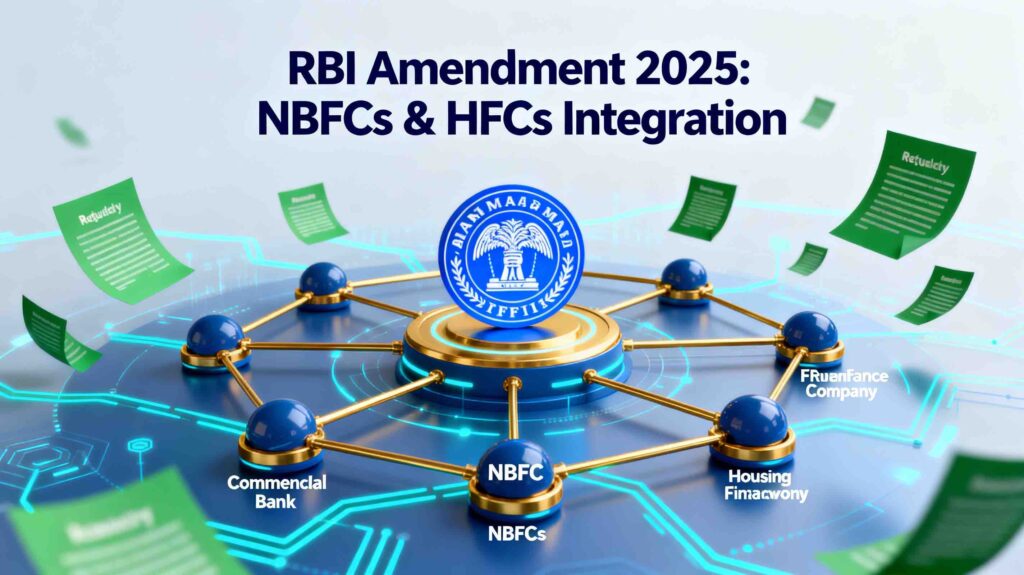
On December 5, 2025, the Reserve Bank of India announced a landmark regulatory update that marks a significant shift in how financial institutions operate under banking groups. The RBI’s amendment to Commercial Banks Directions represents a comprehensive overhaul of the supervisory framework, extending regulatory requirements to encompass Non-Banking Financial Companies and Housing Finance Companies within banking group structures. This development is not merely a technical adjustment; it fundamentally reshapes the regulatory landscape for India’s financial services ecosystem.
Understanding the Amendment: What Changed and Why It Matters
The Reserve Bank of India has issued amended Directions under the 2025 Commercial Banks – Undertaking of Financial Services Directions, which significantly expand the regulatory perimeter beyond traditional banking entities. Previously, regulatory oversight primarily focused on commercial banks themselves, but this new framework extends stringent compliance requirements to all non-banking financial entities operating within a banking group.
The amendment’s core objective centers on creating a harmonised regulatory environmentacross financial groups. Rather than allowing subsidiaries and affiliated entities to operate under different regulatory regimes, the RBI has established a unified set of prudential standards applicable to all group entities. This consolidated supervisory approach addresses what regulators identify as critical gaps in the existing framework—instances where non-core financial activities conducted by group entities could pose systemic risks that were previously overlooked.
The group entity regulations introduced by this amendment specifically target three categories of organizations: NBFCs engaged in lending operations, Housing Finance Companies accepting public deposits, and other non-banking subsidiaries of commercial banks. By bringing these entities under a comprehensive regulatory framework, the RBI aims to eliminate what professionals in the sector call “regulatory arbitrage”—the practice of exploiting differences in regulations across entities to minimize compliance obligations or shift risks strategically.
Scope of Applicability and Timeline for Implementation
One of the most critical aspects for compliance professionals to understand is the precise scope of these amendments. The financial services regulations update applies to all Non-Banking Financial Companies, regardless of their asset size or classification within the existing regulatory structure. This includes Upper Layer NBFCs, Middle Layer entities, and significantly, all Housing Finance Companies that function as group entities of commercial banks operating in India.
The effective date—December 5, 2025—gave immediate effect to these requirements. This swift implementation timeline means that banking groups had minimal transition time to reorganize their operational structures and compliance frameworks. Commercial banks must now ensure that their affiliated NBFCs and HFCs align with revised regulatory expectations pertaining to capital adequacy, liquidity management, risk assessment, and governance standards.
The timing of this amendment is particularly noteworthy because it follows extensive stakeholder consultation. The RBI released draft guidelines in October 2024, soliciting feedback from industry participants, and incorporated substantive revisions based on responses received. This deliberative process demonstrates the RBI’s commitment to crafting regulations that address genuine systemic concerns while remaining operationally feasible for financial institutions.
Key Regulatory Requirements for Group-Level Supervision
The amended directions establish several fundamental requirements that banking groups must immediately address. First among these is the necessity to implement group-level prudential supervision across all affiliated financial entities. This means commercial banks cannot treat their NBFC or HFC subsidiaries as separate, independent operations; instead, they must maintain consolidated oversight of consolidated risks, consolidated capital ratios, and consolidated exposures across the entire banking group.
The second critical requirement involves segregation of activities within banking groups. Core banking functions—particularly the acceptance of deposits—must be conducted exclusively through the bank’s departmental operations. Activities such as mutual fund distribution, insurance, pension fund management, portfolio management services, and brokerage must be undertaken through dedicated group entities only. This structural segregation prevents regulatory overlap and ensures that banking-specific prudential norms cannot be circumvented through group arrangements.
Third, the regulations impose explicit restrictions on lending activities undertaken by NBFC and HFC group entities. These non-banking subsidiaries must comply with upper-layer NBFC regulations (though with certain exemptions) and are subject to the same lending restrictions applied to banks themselves. This includes prohibitions on advancing against the parent bank’s shares, loans to directors and their relatives, financing of promoter contributions, and limitations on various forms of share-based financing.
The amendments also establish ownership caps and investment limits for banking groups. Particularly significant is the 20 percent cap on a banking group’s combined ownership stake in any Asset Reconstruction Company, preventing excessive concentration of control in debt resolution entities. These quantitative limits represent a deliberate regulatory choice to distribute influence and prevent single banking groups from dominating specialized financial services sectors.
Impact on Housing Finance Companies: Harmonization and Compliance
Housing Finance Company regulations have undergone particularly substantial changes through this amendment, as the RBI continues its broader harmonization initiative launched following HFC regulation transfers from the National Housing Bank to the RBI in August 2019. The new framework brings HFC prudential standards substantially closer to those applicable to NBFCs, though with certain concessions acknowledging the specialized nature of housing finance.
One prominent change involves liquid asset maintenance. HFCs must now maintain liquid assets equivalent to 15 percent of their public deposits, compared to the previously applicable 13 percent standard. While seemingly modest, this adjustment requires HFCs to maintain higher cash reserves, affecting their liquidity management and lending capacity. The implementation followed a phased approach, beginning January 1, 2025, with incremental increases through July 2025, providing HFCs reasonable time to reposition their balance sheets.
Additionally, the amendment introduces stricter credit rating requirements. HFCs accepting public deposits must maintain investment-grade credit ratings from recognized rating agencies, with rating reviews conducted annually. Should an HFC’s rating fall below investment grade during the year, the institution cannot accept new deposits or renew existing deposit agreements until ratings improve. This requirement effectively introduces a quality filter into the housing finance sector, potentially constraining growth for smaller or lower-rated HFCs while rewarding institutions with stronger financial positions.
Critical Implications for Banking Groups and Compliance Strategies
For commercial banks maintaining group structures encompassing NBFCs and HFCs, the amendment necessitates comprehensive internal transformation. Banks must undertake complete reviews of their ownership and exposure structures relating to affiliated non-banking entities, assessing whether current arrangements align with the new regulatory framework.
Risk management systems require substantial upgrades. Banks must implement monitoring mechanisms capable of tracking consolidated exposures across group entities, identifying concentration risks, and ensuring compliance with cross-group lending prohibitions. This technological and operational challenge is particularly acute for larger banking groups with complex subsidiary structures spanning multiple financial services sectors.
Governance frameworks also require attention. Boards of commercial banks must establish robust processes for group-level oversight, ensuring that management decisions at the parent bank level account for implications across the entire banking group. This includes structured inter-company transaction approval processes, ensuring that transactions between the bank and its NBFC or HFC subsidiaries receive appropriate scrutiny and comply with prescribed limits.
Regulatory Intent and the Consolidated Supervisory Approach
The broader regulatory intent underlying these amendments reflects the RBI’s commitment to preventing regulatory blind spots within Indian financial groups. The central bank’s updated framework acknowledges that sophisticated banking organizations sometimes structure group entities to exploit regulatory gaps, effectively managing risk in ways that may undermine financial stability objectives.
By implementing this consolidated supervisory approach, the RBI aims to ensure that banking group structures enhance rather than undermine regulatory oversight. This represents a philosophical shift from entity-by-entity supervision toward group-based regulation, aligning Indian banking sector regulation with international best practices observed in developed financial markets.
Compliance Failures and Corrective Measures
The amendment carries teeth. Institutions failing to achieve timely compliance face significant consequences, ranging from tighter supervisory scrutiny and heightened regulatory examinations to restrictions on business expansion, specific corrective action directives, or even enforcement actions against board members and senior management. The RBI has demonstrated increasing willingness to impose corrective action frameworks on non-compliant institutions, making compliance with these new requirements a business-critical priority.
Looking Forward: Strategic Considerations
Banking groups must recognize this amendment not as an isolated regulatory adjustment but as evidence of evolving RBI expectations regarding risk management and financial stability. The amendment likely foreshadows additional regulatory refinements as the central bank continues assessing whether current group structures adequately balance innovation and stability objectives.
Institutions should view this regulatory development as an opportunity to strengthen internal controls, enhance governance practices, and demonstrate proactive compliance commitment. Banks that rapidly adapt their structures and processes to align with the new framework will be better positioned for future regulatory developments while reducing their exposure to supervisory action.
The amendment to Commercial Banks Directions ultimately reflects a maturing regulatory environment where sophisticated structures carry correspondingly sophisticated regulatory expectations. Financial institutions embracing this reality and investing in comprehensive compliance transformation will navigate the evolving regulatory landscape more effectively than competitors proceeding incrementally.
- Planning a Gold Loan in 2026? This New RBI Rule Could Slash Your Cash by Thousands Overnight
 April 2026 brings RBI’s new gold loan regulations with tiered LTV limits: 85% for loans under ₹2.5 lakh, 80% for ₹2.5–5 lakh, and 75% above. Understand how these rules impact your borrowing capacity and protect your precious ornaments.
 - Stop Paying Your Bank! RBI’s New Zero-Balance Rules Could Save You Over ₹5,000 Every Year
 Your bank account shouldn’t drain your pocket. Millions of Indians lose ₹5,000+ yearly to hidden charges and penalties. The RBI’s revised zero-balance account rules—effective April 2026—eliminate these fees entirely. Discover how to save thousands while maintaining complete banking access.
 - Big Relief for Businesses: RBI Relaxes Current Account Norms; Major Changes Effective April 2026
 The RBI’s December 2025 amendments fundamentally reshape business financing by removing restrictions on cash credit accounts and raising current account thresholds to Rs 10 crore. These relaxations in current and cash credit norms enhance working capital accessibility, enabling businesses to optimize liquidity management and reduce operational financing costs significantly.
 - One Rule for All: How RBI’s Standardized Minimum Balance Will Change Your Banking in 2026
 The Reserve Bank of India’s updated minimum balance framework, effective December 10, 2025, reduces penalties to ₹200 maximum and introduces flexible thresholds. Urban savings accounts require ₹500 minimum, rural accounts ₹200, while zero balance BSBD accounts eliminate requirements entirely, promoting financial inclusion across India’s banking sector.
 - No More Shortcuts: RBI Plugs Regulatory Gaps for NBFCs and HFCs in Landmark December Amendment
 The RBI’s December 2025 amendment extends regulatory oversight to Non-Banking Financial Companies and Housing Finance Companies within banking groups. This consolidated supervisory framework eliminates regulatory gaps, enforces harmonized prudential standards, and ensures comprehensive group-level risk management across India’s financial services sector.
 - Is This the Best Time to Borrow? India Enters Rare ‘Goldilocks’ Phase as RBI Slashes Rates
 The RBI cut the repo rate by 25 basis points to 5.25%, supporting economic growth while maintaining inflation control. This rate reduction lowers borrowing costs for home loans, personal loans, and businesses, encouraging consumption and investment across the economy.
 - Is Your Money Safer? Understanding the RBI’s Massive October Policy Shift and New ‘Gold Standard’ for Banks
 Explore RBI’s October 2025 regulatory overhaul strengthening Basel III capital norms and launching the FREE-AI framework to ensure responsible AI adoption and safer banking innovation in India.
 - ₹20 Lakh Special Prize: RBI’s HaRBInger 2025 Is Searching for India’s Best All-Woman Tech Team
 RBI’s HaRBInger 2025 global hackathon drives innovation in secure, inclusive banking with cutting-edge fintech solutions. Focused on tokenized KYC, offline CBDC, and digital trust, it empowers startups to transform India’s digital banking landscape safely and accessibly.
 - Gold Loan Repaid? Banks Must Now Return Your Jewellery in 7 Days or Pay You ₹5,000 Daily Penalty!
 The Reserve Bank of India (RBI) sets clear rules for lending against gold, allowing banks and financial firms to offer short-term loans using pledged gold or silver jewellery and coins, helping borrowers access cash without selling assets while safeguarding lenders.
Pingback: Save ₹5,000+ Annually With RBI Zero-Balance Account Rules