
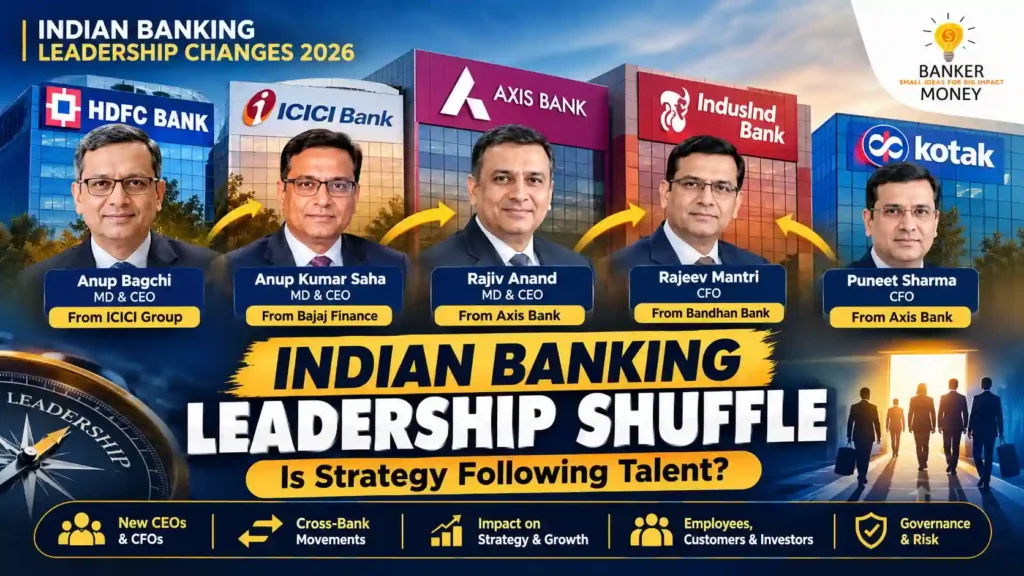
Indian banking is witnessing an intriguing game of musical chairs. A leader who spent decades in the ICICI Group is preparing to head HDFC Bank. An experienced Axis Bank executive is leading IndusInd Bank. Meanwhile, senior finance executives are moving between Axis, HDFC and Bandhan Bank.
Are banks simply hiring experienced professionals, or are India’s private banks gradually becoming more alike?
The recent Indian banking leadership changes in 2026 raise an important question: when executives change employers, do they bring their former institution’s strategy with them, or do they adapt to the new bank’s ambitions?
1. The great banking leadership shuffle
Several developments make this an interesting moment for the Indian banking sector.
On October 27, 2026, Anup Bagchi is scheduled to take over as MD & CEO of HDFC Bank for a three-year term, succeeding Sashidhar Jagdishan, whose tenure concludes on October 26. The Reserve Bank of India has approved the appointment, subject to shareholder approval.
Bagchi has been associated with the ICICI Group since 1992. He has led ICICI Securities and ICICI Prudential Life Insurance and served as an executive director at ICICI Bank. His appointment gives HDFC Bank a leader with extensive experience across banking, insurance, capital markets and digital financial services.
Kotak Mahindra Bank has also announced a significant succession. The RBI has approved Anup Kumar Saha as MD & CEO for a three-year term beginning January 1, 2027, succeeding Ashok Vaswani. Saha joined Kotak in January 2026 after senior roles at Bajaj Finance and ICICI Bank.
Then there is IndusInd Bank. Rajiv Anand, formerly Deputy MD of Axis Bank, became IndusInd Bank’s MD & CEO on August 25, 2025. Although this move predates the current wave of 2026 appointments, it is an important part of the broader leadership story.
The picture becomes even more interesting when we look beyond CEO positions.
2. Who is moving where?
| Bank | Leadership change | Strategic significance |
|---|---|---|
| HDFC Bank | Anup Bagchi succeeds Sashidhar Jagdishan from October 27, 2026 | Leadership transition involving an ICICI Group veteran |
| Kotak Mahindra Bank | Anup Kumar Saha succeeds Ashok Vaswani from January 1, 2027 | Retail banking experience and execution become important priorities |
| IndusInd Bank | Rajiv Anand joined as MD & CEO on August 25, 2025 | An experienced Axis executive leads a new phase at IndusInd |
| Axis Bank | Rajeev Mantri joined as CFO on September 28, 2026, following his departure from Bandhan Bank | New finance leadership with experience in banking strategy and financial controls |
| HDFC Bank | Puneet Sharma moves from Axis Bank into the CFO role, effective December 1, 2026 | Finance leadership and institutional expertise cross bank boundaries |
| ICICI Prudential Life Insurance | Sidharatha Sankar Mishra was named as Anup Bagchi’s successor, subject to regulatory approvals | Leadership continuity within the ICICI Group |
The CFO moves deserve particular attention. Rajeev Mantri previously served as CFO of Bandhan Bank and joined Axis Bank as CFO on September 28, 2026. Puneet Sharma, Axis Bank’s outgoing CFO, is scheduled to assume the corresponding role at HDFC Bank on December 1, 2026, having joined as CFO-designate on September 1.
These transitions demonstrate how banks compete for finance professionals who understand capital management, investor communication, regulatory compliance and business performance.
One detail requires caution: Bandhan Bank’s current leadership information lists Vinay Jain as interim CFO, while an August report described TransUnion CIBIL CFO Amol Joshi as a potential successor. The reported possibility should not be treated as a confirmed appointment.
Similarly, Axis Bank has officially disclosed Sanjeev Moghe’s resignation, effective at the close of business on October 30, 2026, to pursue an external opportunity. I could not verify a public announcement confirming that Sandeep Kumar will replace him or that Moghe is joining IndusInd. Those claims should remain unconfirmed until supported by an official disclosure.
3. Is HDFC the new ICICI, IndusInd the new Axis, and Axis the new HDFC?
It is a catchy theory, but how well does it hold up?
HDFC Bank becoming the new ICICI?
Bagchi’s appointment makes the comparison understandable. He brings decades of ICICI Group experience and a background spanning retail banking, wholesale banking and insurance.
However, hiring an executive from a competitor does not automatically transfer that competitor’s culture. HDFC Bank has its own customer base, governance structures, operating systems and strategic priorities. Bagchi may introduce new approaches, but their success will depend on how effectively they fit HDFC’s business model.
IndusInd Bank becoming the new Axis?
The connection is more direct at the individual level. Rajiv Anand spent years at Axis Bank, including overseeing wholesale banking and digital banking responsibilities, before becoming IndusInd’s CEO.
His experience could help IndusInd strengthen business execution, digital capabilities, risk discipline and relationships with corporate customers. But rebuilding confidence and achieving sustainable growth require more than importing a leader’s experience. They require effective controls, reliable systems and consistent execution.
Axis Bank becoming the new HDFC?
This is the least established part of the theory. Puneet Sharma’s move is in the opposite direction, from Axis to HDFC, while Mantri’s move brings experience from Bandhan and other financial institutions into Axis. These appointments show talent circulation, but they do not establish that Axis is becoming culturally or strategically similar to HDFC.
The larger pattern is therefore not that banks are becoming identical. It is that their leadership talent pools increasingly overlap.
4. What does leadership mobility mean for a bank?
The impact can be positive or negative.
The upside: fresh thinking and stronger execution
A leader arriving from another institution may challenge outdated practices and introduce better approaches to deposit mobilisation, risk management, digital services and customer acquisition.
An experienced CFO, for example, may bring stronger financial forecasting, clearer capital allocation and improved communication with investors. A CEO with a strong retail banking background may sharpen the focus on customer relationships and profitable growth.
External appointments can also encourage internal teams to reconsider established routines. Healthy competition between internal talent and experienced external hires can improve succession planning and management standards.
The downside: culture clashes and execution risk
A strategy that worked at one bank may fail at another.
Different banks have different customer segments, cost structures, technology platforms and risk appetites. Even an outstanding executive needs time to understand these differences.
Employees may also face changes in targets, reporting structures, incentive systems and management expectations. If too many senior leaders change at once, decision-making can slow down, institutional knowledge can be lost, and talented employees may feel their promotion opportunities are shrinking.
For customers, the main risk is disruption to service quality or relationship continuity. Shareholders, meanwhile, must remember that a high-profile appointment is not a guarantee of improved profitability or stock-market returns.
5. The real test: employees, customers and shareholders
For bank employees, leadership changes can create opportunities for faster career growth, but also uncertainty about targets, promotions and organisational priorities.
For customers, the important questions are practical: Will service improve? Will digital transactions become easier? Will credit decisions be faster? Will the bank continue to understand their financial needs?
For investors, the indicators that matter are measurable outcomes: deposit growth, cost of funds, net interest margins, asset quality, return on assets, return on equity and capital adequacy.
Leadership announcements can influence expectations, but financial results over subsequent quarters are needed to evaluate whether the new management team is delivering.
Governance also matters. In banking, growth without sound underwriting, reliable internal controls and regulatory compliance can create long-term problems. The right leader must balance commercial ambition with risk discipline.
6. What could happen over the next three years?
The next phase will reveal whether these appointments produce genuine strategic changes or simply reflect a more competitive executive labour market.
HDFC Bank will need to demonstrate how Bagchi’s experience translates into its own strategy following the merger of HDFC Ltd with the bank. Kotak will need to show whether Saha can accelerate growth and strengthen deposit mobilisation. IndusInd will need to demonstrate consistent execution under Anand, while Axis and HDFC will have to manage their finance leadership transitions without losing operational continuity.
None of these outcomes is guaranteed.
The verdict
India’s private banks are not necessarily exchanging identities. They are exchanging experience, networks and leadership capabilities.
A leader may move from one bank to another, but sustainable success comes from the institution’s ability to combine that leader’s experience with the right people, culture, governance and strategy.
Over time, financial performance will determine whether this leadership shuffle was a turning point for Indian banking or simply another chapter in the competition for talent.
What do you think? Is HDFC becoming more like ICICI, is IndusInd adopting elements of Axis Bank’s approach, or are we overestimating the influence of individual leaders? Share your views in the comments.
- Is HDFC Becoming ICICI? The Executive Moves Reshaping Indian Banking
 Explore India’s banking leadership changes in 2026 as top executives move between HDFC Bank, ICICI Group, Axis Bank, IndusInd Bank and Kotak Mahindra Bank. Discover how CEO and CFO transitions could reshape banking strategies, organisational culture, employee careers and customer experiences.
- The 2026 Nationwide 3 Days Bank Strike: Why India’s Banking Backbone is Breaking
 Discover the root causes of the 2026 nationwide bank strike. Explore the struggle for 5-day banking, fair incentives, and why a Uniform Banking Standard is urgently needed to protect the dignity and job security of all bank employees.
- UPI MDR 2026: Is UPI Still Free? Here’s the Real Answer
 A simple guide to the new UPI MDR rules effective October 15, 2026 — who pays the 0.4% merchant charge, who doesn’t, and why UPI stays free for customers.
- Sole Proprietorship in India: Do You Need Registration? Documents & Benefits Explained
 Learn how to start a sole proprietorship firm in India, understand registration requirements, benefits, GST and Udyam registration, and discover the essential documents needed to open a business bank account. A simple beginner’s guide to launching your business confidently and correctly.
- What is HUF? The Ancient Rule Letting Modern Families Unlock Double Tax Benefits
 Want to legally save on income tax? Discover how a Hindu Undivided Family (HUF) protects wealth and maximizes tax benefits. Explore our complete guide on HUF eligibility, the 2005 amendment, and step-by-step instructions to open an HUF bank account.