
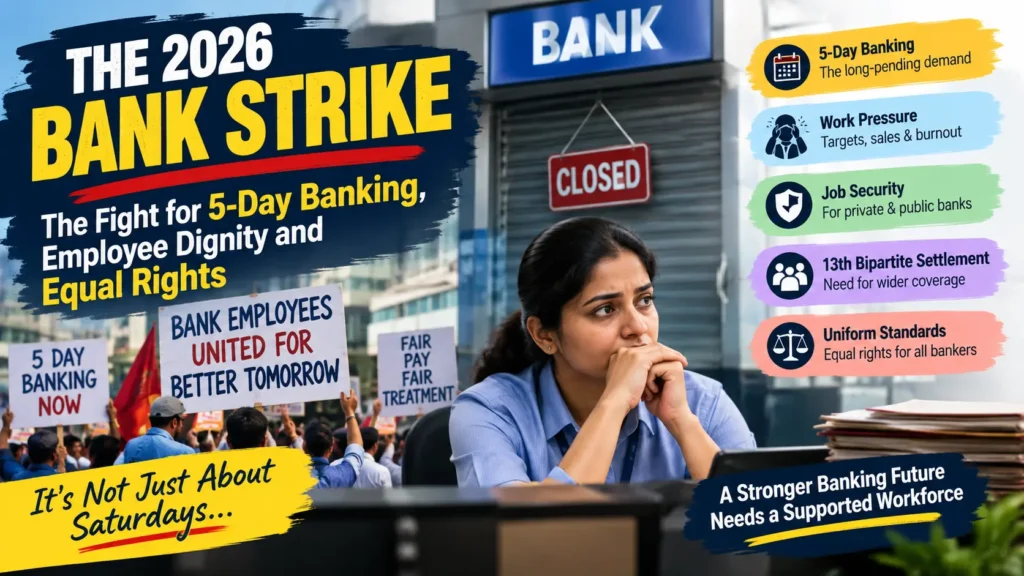
The doors of India’s public sector banks are closed from September 28 to September 30, 2026. Behind the locked shutters and halted cheque clearances lies a brewing storm that has been gathering for years.
Called by the United Forum of Bank Unions (UFBU), this three-day strike is not just a routine demand for higher wages. It is a desperate cry for work-life balance, fair compensation, and fundamentally, basic human dignity in a high-pressure industry. But how did we get here, and what does this mean for the future of Indian banking?
The Root of the Conflict: A Promise Delayed
To understand the current crisis, we have to look back. In 2015, an agreement granted bank employees the second and fourth Saturdays off. The understanding was that a full transition to a 5-day work week would eventually follow.
Fast forward to March 2024: the Indian Banks’ Association (IBA) and bank unions signed a Memorandum of Understanding (MoU) agreeing to a 5-day banking week. Bank employees even agreed to work an extra 40 minutes every weekday to compensate for the lost hours. Yet, more than 30 months later, the file gathers dust, with the government continuously stating the matter is “under consideration.”
Adding fuel to the fire is the highly controversial Performance Linked Incentive (PLI) scheme. In its current shape, the PLI is glaringly disproportionate. Top executives (Scale 4 and above) can take home up to an entire year’s salary as an incentive, while the grassroots employees the clerks and scale 1-3 officers who handle the exhausting daily customer interactions are capped at a mere 15 days’ pay.
The Human Cost: The Silent Struggle of the Bank Employee
The modern bank employee is fighting a battle on two fronts. On one side is the massive burden of social and government banking. From managing massive TASC (Trust, Association, Society, and Club) portfolios to ensuring the seamless execution of Direct Benefit Transfers and Jan Dhan accounts, public sector bankers are the uncredited engines of India’s financial inclusion.
On the other side is the aggressive, corporate-style push for cross-selling. Today’s bankers face relentless pressure to sell third-party products like mutual funds and insurance policies, often while battling severe staff shortages.
The result? An alarming mental health crisis. With unrealistic targets, late-night closures and the constant fear of disciplinary action, the banking sector has seen a tragic rise in employee burnout and even suicides. The 5-day week is no longer a luxury; it is a medical necessity.
The Great Divide: PSU vs. Private Sector Banks
While public sector banks bear the brunt of social banking, private sector banks operate with a singular, relentless focus on profitability. Yet, the employees in the private sector are not faring much better.
Private bank employees often face a brutal “hire and fire” culture, with extreme target pressures and virtually zero job security. While digital banking and AI are heavily pushed to reduce branch dependency, the reality is that the financial sector still requires human connection, and those humans are being stretched to their breaking limits across both sectors.
The Way Forward: A Uniform Banking Standard
If we want to build a robust, globally competitive financial ecosystem, the deeply fragmented way we treat bank employees must end. The solution lies in establishing a Uniform Banking Standard that applies equally across both Public Sector Undertakings (PSUs) and Private Banks.
A banker is a banker, regardless of the logo on their ID card. Every employee deserves to live and work with dignity, free from the constant anxiety of job insecurity.
One highly effective way to achieve this is to bring the new-generation private bank employees under the umbrella of the Bipartite Settlements. We already have a successful precedent for this: old-generation private banks like Karnataka Bank, Federal Bank, and South Indian Bank have historically participated in the Bipartite wage settlements alongside PSUs.
As the industry gears up for the upcoming 13th Bipartite Settlement, extending this framework to all private sector banks would be a game-changer. It would ensure:
- Standardized working hours and the universal implementation of 5-day banking.
- Protection against arbitrary terminations and toxic sales cultures.
- Equitable performance incentive structures that reward the entire team, not just the top executives.
Conclusion: The Clock is Ticking
The September strike is a warning shot. The UFBU has already laid its cards on the table: if a concrete timeline for the 5-day week and a fair PLI correction is not provided, the nation will face an indefinite bank strike starting October 26, 2026.
It is time for the policymakers to realize that banking cannot run efficiently on the fumes of exhausted employees. By bridging the gap between PSU and private banks and ensuring a uniform standard of dignity and security, we can build a stronger, healthier banking sector for tomorrow.
- The 2026 Nationwide 3 Days Bank Strike: Why India’s Banking Backbone is Breaking
 Discover the root causes of the 2026 nationwide bank strike. Explore the struggle for 5-day banking, fair incentives, and why a Uniform Banking Standard is urgently needed to protect the dignity and job security of all bank employees.
 - UPI MDR 2026: Is UPI Still Free? Here’s the Real Answer
 A simple guide to the new UPI MDR rules effective October 15, 2026 — who pays the 0.4% merchant charge, who doesn’t, and why UPI stays free for customers.
 - Sole Proprietorship in India: Do You Need Registration? Documents & Benefits Explained
 Learn how to start a sole proprietorship firm in India, understand registration requirements, benefits, GST and Udyam registration, and discover the essential documents needed to open a business bank account. A simple beginner’s guide to launching your business confidently and correctly.
 - What is HUF? The Ancient Rule Letting Modern Families Unlock Double Tax Benefits
 Want to legally save on income tax? Discover how a Hindu Undivided Family (HUF) protects wealth and maximizes tax benefits. Explore our complete guide on HUF eligibility, the 2005 amendment, and step-by-step instructions to open an HUF bank account.
 - Exposed by RTI: Banks Recover 74% from Small Borrowers, Just 14% from Giants
 Shocking RTI data reveals a massive banking divide: banks recover 74% of bad loans from small borrowers but only 14.5% from corporate giants. Discover why ordinary citizens face harsh recovery agents while large defaulters enjoy massive loan write-offs.