
Imagine missing a couple of EMIs on your home, car or small business loan. Within weeks, your phone will inevitably blow up with relentless calls from recovery agents. Your CIBIL score will plummet, effectively locking you out of the credit market. Shortly after, you might even find an asset seizure notice pinned to your front door.
Now, imagine you are a corporate giant defaulting on a loan worth thousands of crores. What happens then? Instead of recovery agents at your doorstep, you get a seat at a comfortable negotiation table. You are offered years of debt restructuring, a strategic resolution process, and eventually, a massive write-off where the bank takes a significant “haircut”.
For years, the Indian middle class and small business owners have felt that the banking system operates on a double standard. Recently, a startling Right to Information (RTI) response regarding the Central Bank of India’s bad loans didn’t just validate this suspicion—it quantified it.
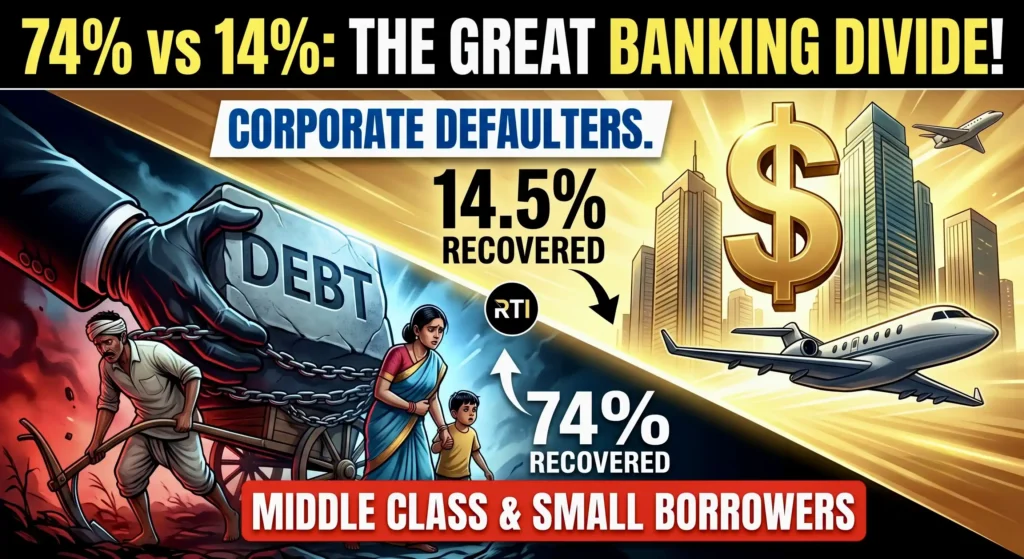
The revelation? When a small borrower defaults, the bank manages to recover a staggering 74% of the dues. But when a large corporate borrower defaults, the recovery rate crashes to a mere 14.5%.
Let’s dive into what these numbers actually mean, why the loan recovery rates in India are so deeply skewed, and what this disparity says about our financial ecosystem.
The Shocking RTI Data: Decoding the 74% vs. 14.5% Disparity
The viral discourse surrounding this issue stems from an RTI query that sought data on loan write-offs and recoveries from the Central Bank of India over the last six financial years. The statistics provided a stark, unfiltered look into the realities of NPA recovery (Non-Performing Assets).
To truly understand the gravity of the situation, we have to look past the percentages and examine the absolute numbers regarding the amounts recovered from written-off accounts:
- For Small Borrowers: Out of ₹6,774.23 crore written off by the bank, they successfully recovered ₹5,004.28 crore. That translates to an impressive 74% recovery rate.
- For Large Borrowers: The bank wrote off a colossal ₹26,701.55 crore in large corporate bad loans. Out of this massive sum, they managed to recover only ₹3,874.41 crore. That is a paltry 14.5%.
Same bank. Same regulatory framework. Two drastically different outcomes.
It is important to clarify a technical nuance here: these percentages represent the recovery of written-off loans, not the total loan book. However, the contrast in how successfully banks squeeze water from a stone when dealing with retail clients versus large corporations is undeniable.
A Tale of Two Defaults: The Small Business vs. The Corporate Giant
To understand why this gap exists, we have to look at the mechanics of retail loan default consequences versus corporate insolvency.
The Small Borrower’s Ordeal
When an individual or a Micro, Small, and Medium Enterprise (MSME) defaults on a loan, the bank’s reaction is swift and severe. Thanks to acts like the SARFAESI Act (Securitisation and Reconstruction of Financial Assets and Enforcement of Security Interest Act), banks possess immense power to bypass the courts and directly auction off residential or commercial properties pledged as collateral.
Small borrowers do not have armies of lawyers. They cannot afford to drag cases through tribunals for half a decade. When the recovery agents show up, the small borrower usually liquidates whatever personal assets they have left—borrowing from family, selling gold, or auctioning their home—just to clear the dues and escape the harassment. Hence, the 74% recovery rate. The fear of social stigma and the immediate loss of livelihood force small borrowers to pay up, no matter the personal cost.
The Corporate “Haircut” Culture
Now, let’s pivot to large corporate defaulters. When a mega-corporation fails to repay a ₹5,000 crore loan, the dynamics completely flip. The sheer size of the default means that if the company goes under, thousands of jobs are lost, and the bank’s balance sheet takes a fatal hit. Suddenly, the bank is just as trapped as the borrower.
Large bad loans usually end up in the National Company Law Tribunal (NCLT) under the Insolvency and Bankruptcy Code (IBC). While the IBC was designed to clean up the banking system, it has inadvertently normalized NCLT haircuts—a financial jargon term meaning the bank agrees to accept significantly less than what it is owed to resolve the bad debt.
Corporate defaulters undergo prolonged periods of debt restructuring. Their promoters often utilize legal loopholes to delay proceedings for years. By the time a resolution is reached, the assets have depreciated, and the banks are forced to write off thousands of crores, settling for pennies on the rupee. This is exactly why the recovery rate for large borrowers sits at a dismal 14.5%.
The Shield of Anonymity: Protecting the Powerful
Perhaps the most infuriating aspect of this entire ordeal is the lack of transparency regarding who these large defaulters actually are.
When the RTI activist who obtained the Central Bank of India data asked for the names of the large corporate defaulters whose loans resulted in these massive write-offs, the bank flatly refused. They cited legal exemptions, claiming that disclosing borrower names breaches fiduciary trust and confidentiality clauses.
Think about the sheer irony of this policy. If a farmer defaults on a tractor loan, or a middle-class family defaults on an education loan, their names and photographs are frequently published in local newspapers as “defaulters” to shame them into paying.
Yet, when a handful of ultra-rich industrialists wipe out ₹26,000+ crore of public money, they are granted the luxury of absolute anonymity. The law protects their reputation, while the ordinary taxpayer ultimately absorbs the financial shock through bank recapitalizations funded by the government.
Are We Funding a One-Sided System?
This brings us to a harsh economic reality: the people who pay their loans on time, and the small borrowers who are squeezed for every last penny, are the ones actively funding the stability of the Indian banking system.
Banks inherently rely on the steady interest payments from retail loans (home loans, personal loans, auto loans) and small business credit to maintain their profitability. The high recovery rates from the middle and lower-middle classes create a financial cushion. Unfortunately, this cushion is often utilized to absorb the shock of corporate loan write-offs.
When a bank writes off a massive corporate loan, it is essentially removing that toxic asset from its active balance sheet to make its financial health look better to investors and regulators. While a write-off does not legally stop the bank from pursuing recovery, the historical data proves that once a large loan is written off, retrieving that money is nearly impossible. The 14.5% statistic is the smoking gun.
Why Systemic Reform is the Need of the Hour
Defenders of the current system will argue that corporate loans are infinitely more complex than retail loans. They will point out that businesses operate subject to market risks, global supply chain disruptions, and economic downturns. They will argue that saving a company through a massive haircut is better than liquidating it entirely and losing thousands of jobs.
While there is partial truth to this macroeconomic argument, it cannot be used as a permanent blanket excuse for crony capitalism. The sheer magnitude of the disparity—74% versus 14.5%—indicates a deep, structural flaw in how risk is assessed and how recovery is enforced.
If the Indian banking sector wants to build genuine trust with the public, several systemic reforms must be prioritized:
- Equal Transparency: The legal framework must be amended to lift the veil of anonymity on large corporate defaulters. If public money is being written off, the public has a fundamental right to know whose debts they are subsidizing.
- Stricter Collateral Norms for Corporates: Just as small business owners are asked to pledge their homes to secure a loan, corporate promoters should face stricter personal guarantor regulations. The corporate veil must not protect personal wealth amassed through diverted bank funds.
- Faster NCLT Resolutions: The IBC tribunals must be expanded and expedited. The longer a corporate insolvency drags on, the lower the recovery value of the underlying assets.
- Empathy for Retail Borrowers: The aggressive, and often unethical, tactics used by third-party recovery agents against small borrowers need strict regulatory crackdowns by the RBI. If corporate giants are afforded “restructuring,” small borrowers facing genuine financial distress should be offered realistic rehabilitation plans before asset seizure.
Final Thoughts
The Central Bank of India RTI data is not an anomaly; it is a symptom of a much larger pattern embedded in our financial system. It confirms what the average citizen has always suspected: the rulebook changes depending on the size of your wallet.
When you owe the bank ₹5 lakh, the bank owns you. But when you owe the bank ₹5,000 crore, you own the bank.
Until the regulatory bodies and policymakers bridge this glaring divide, the burden of India’s economic growth will continue to disproportionately rest on the shoulders of the honest, small-scale borrower. It is high time we demand a banking system where accountability is not a privilege of the poor, but a mandatory standard for the rich.
- The 2026 Nationwide 3 Days Bank Strike: Why India’s Banking Backbone is Breaking
 Discover the root causes of the 2026 nationwide bank strike. Explore the struggle for 5-day banking, fair incentives, and why a Uniform Banking Standard is urgently needed to protect the dignity and job security of all bank employees.
 - UPI MDR 2026: Is UPI Still Free? Here’s the Real Answer
 A simple guide to the new UPI MDR rules effective October 15, 2026 — who pays the 0.4% merchant charge, who doesn’t, and why UPI stays free for customers.
 - Sole Proprietorship in India: Do You Need Registration? Documents & Benefits Explained
 Learn how to start a sole proprietorship firm in India, understand registration requirements, benefits, GST and Udyam registration, and discover the essential documents needed to open a business bank account. A simple beginner’s guide to launching your business confidently and correctly.
 - What is HUF? The Ancient Rule Letting Modern Families Unlock Double Tax Benefits
 Want to legally save on income tax? Discover how a Hindu Undivided Family (HUF) protects wealth and maximizes tax benefits. Explore our complete guide on HUF eligibility, the 2005 amendment, and step-by-step instructions to open an HUF bank account.
 - Exposed by RTI: Banks Recover 74% from Small Borrowers, Just 14% from Giants
 Shocking RTI data reveals a massive banking divide: banks recover 74% of bad loans from small borrowers but only 14.5% from corporate giants. Discover why ordinary citizens face harsh recovery agents while large defaulters enjoy massive loan write-offs.