
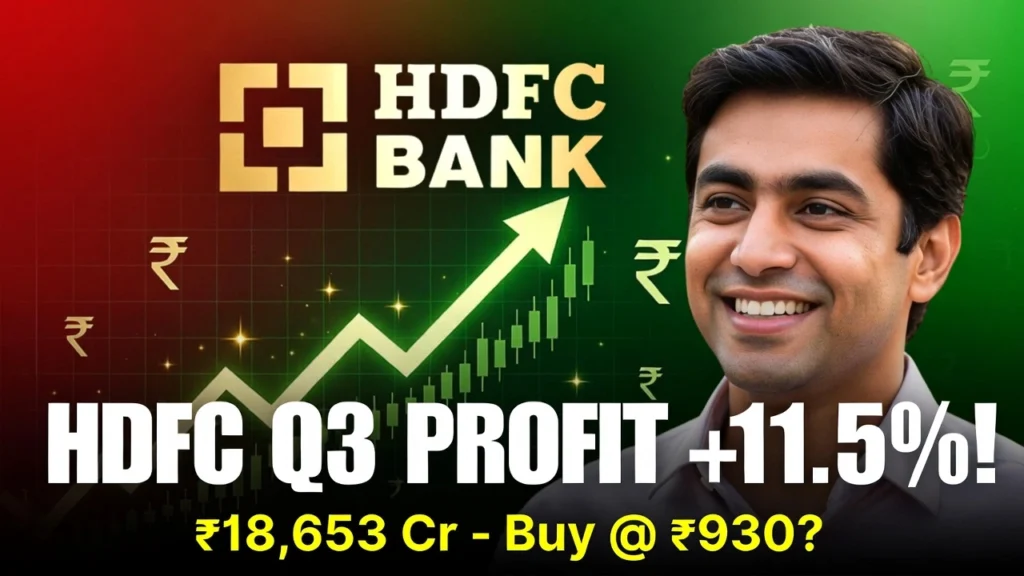
The Indian banking sector’s earnings season has kicked off with a bang and as always, the industry bellwether has set the tone. HDFC Bank, India’s largest private sector lender, announced its financial results for the third quarter of FY26 (ending December 31, 2025) on January 16, 2026. The numbers are out and they tell a story of resilience, steady growth and improving asset quality in a challenging economic environment.
For investors tracking the Nifty Bank index and looking for the best banking stocks to buy in 2026, this report is critical. With the stock currently trading around ₹931, the big question is: Does this double-digit profit growth justify a fresh entry? Let’s dive into the HDFC Bank Q3 results and see how it stacks up against peers like ICICI Bank and SBI.
1. The Headline Numbers: A Solid Beat
HDFC Bank has once again demonstrated why it commands a premium valuation. The bank reported a standalone net profit of ₹18,653 crore, marking a robust 11.5% year-on-year (YoY) increase from ₹16,735 crore in the same quarter last year. This performance slightly beat the Street’s expectations, which had pegged the profit closer to ₹17,968 crore.
Key Financial Highlights (Q3 FY26):
- Net Profit: ₹18,653 crore (+11.5% YoY)
- Net Interest Income (NII): ₹32,615 crore (+6.4% YoY)
- Gross Advances: ₹28.44 lakh crore (+11.9% YoY)
- Total Deposits: ₹28.5 lakh crore (+11.5% YoY)
While the Net Interest Income (NII) growth of 6.4% was modest, it reflects the bank’s strategic shift towards balancing margins over aggressive loan book expansion. The double-digit growth in both advances and deposits signals that the bank’s “deposit war” strategy is stabilizing, a positive sign for long-term investors.
2. Asset Quality: The Star of the Show
One of the most encouraging aspects of the HDFC Bank Q3 results was the improvement in asset quality. For any banking stock, the Gross NPA (Non-Performing Assets) ratio is a “make or break” metric.
- Gross NPA Ratio: Improved to 1.24% (down from 1.42% in Q3 FY25).
- Net NPA Ratio: Came in at 0.42%, significantly better than the 0.46% recorded a year ago.
This improvement comes despite a high-interest rate environment where borrower repayment capacity is typically tested. HDFC Bank’s ability to lower its provisions while growing its loan book speaks volumes about its underwriting standards. For conservative investors, this stability makes it a safer bet compared to more volatile PSU counterparts.
3. Deposit Growth & The Liquidity Battle
The entire banking sector has been grappling with a “war for deposits” throughout FY25 and FY26. HDFC Bank seems to be winning this battle.
The bank’s CASA (Current Account Savings Account) deposits, which are a source of low-cost funds, grew by roughly 10% YoY to ~₹9.6 lakh crore. More importantly, time deposits (fixed deposits) surged by over 13%, indicating that customers are locking in money at higher rates. This robust deposit mobilization is crucial because it brings down the bank’s Credit-to-Deposit (CD) Ratio, a metric regulators have been watching closely.
4. Competitor Analysis: HDFC Bank vs. The Pack
To understand the true value of these results, we must perform a competitor analysis against other heavyweights in the banking sector outlook.
| Metric | HDFC Bank (Q3 FY26) | ICICI Bank (Expected Trend) | SBI (Public Sector Benchmark) |
|---|---|---|---|
| Profit Growth | 11.5% | Analysts expect ~12-14% | Volatile due to wage revisions |
| Asset Quality (GNPA) | 1.24% | Consistently < 2.5% | Typically higher (>2.5%) |
| Stock Price Trend | Stable/Consolidating | High Momentum | Value Play |
| Valuation | Premium P/E | Moderate P/E | Low P/E |
- ICICI Bank: Often seen as HDFC’s main rival for the “top growth stock” title. Investors should watch the ICICI Bank share price closely when they announce results later this month. If ICICI posts superior NII growth, money might rotate there temporarily.
- SBI (State Bank of India): While SBI offers value, its earnings are often lumpier. HDFC Bank offers predictability, which is why it often commands a higher weight in the Nifty Bank index.
- Kotak Mahindra Bank: Continues to trade at high valuations but has struggled with leadership transitions recently, making HDFC Bank appear more stable operationally.
5. Stock Market Impact: What to Expect on Monday?
The HDFC Bank share price closed at ₹931.10 on Friday, January 16, 2026. Following the stock split in mid-2025 (which adjusted the price from the ₹1600-1700 levels), the stock has been consolidating.
Technical Outlook:
- Support: The stock has strong support near the ₹900-910 zone.
- Resistance: A breakout above ₹950 could open the doors for a rally toward ₹1,000.
- Analyst Ratings: Brokerages like CLSA have maintained an ‘Outperform’ rating with targets as high as ₹1,200, citing the bank’s formidable franchise and improving margins.
Given that the profit beat estimates and asset quality improved, the immediate market reaction on Monday is likely to be positive. However, traders should watch the Nifty Bank sentiment, as global cues can often overshadow individual earnings.
6. Final Verdict: Investment Strategy
Is it time to add HDFC Bank to your portfolio?
- For Long-term Investors: Yes. The bank has successfully navigated its merger integration and is back to delivering consistent 15-18% profit growth (CAGR). At ₹930, it offers a decent entry point for a 2-3 year horizon.
- For Traders: The stock is known for being a “slow mover.” Don’t expect a 10% circuit on Monday. Look for “buy on dips” opportunities near ₹920 for a target of ₹960 in the short term.
Conclusion
HDFC Bank’s Q3 FY26 results are a testament to its fortress-like balance sheet. While the days of 20% loan growth might be moderating, the focus on profitability and asset quality ensures it remains a cornerstone of any Indian equity portfolio. As the banking sector enters the final quarter of FY26, HDFC Bank remains the “elephant that can dance”—albeit at a steady, measured pace.
Disclaimer: This blog is for informational purposes only and does not constitute financial advice. Please consult your financial advisor before making any investment decisions.
- Planning a Gold Loan in 2026? This New RBI Rule Could Slash Your Cash by Thousands Overnight
 April 2026 brings RBI’s new gold loan regulations with tiered LTV limits: 85% for loans under ₹2.5 lakh, 80% for ₹2.5–5 lakh, and 75% above. Understand how these rules impact your borrowing capacity and protect your precious ornaments.
 - Stop Paying Your Bank! RBI’s New Zero-Balance Rules Could Save You Over ₹5,000 Every Year
 Your bank account shouldn’t drain your pocket. Millions of Indians lose ₹5,000+ yearly to hidden charges and penalties. The RBI’s revised zero-balance account rules—effective April 2026—eliminate these fees entirely. Discover how to save thousands while maintaining complete banking access.
 - Big Relief for Businesses: RBI Relaxes Current Account Norms; Major Changes Effective April 2026
 The RBI’s December 2025 amendments fundamentally reshape business financing by removing restrictions on cash credit accounts and raising current account thresholds to Rs 10 crore. These relaxations in current and cash credit norms enhance working capital accessibility, enabling businesses to optimize liquidity management and reduce operational financing costs significantly.
 - New RBI Nomination Rules Are Now Live: The Simple Change to Prevent Your Funds From Being Locked
 The RBI’s new bank account nomination rules 2025 allow up to four nominees with digital registration. Learn how these changes simplify claim settlement, protect your family’s financial security, and why updating your nomination matters today.
 - Is Your Money Safer? Understanding the RBI’s Massive October Policy Shift and New ‘Gold Standard’ for Banks
 Explore RBI’s October 2025 regulatory overhaul strengthening Basel III capital norms and launching the FREE-AI framework to ensure responsible AI adoption and safer banking innovation in India.
 - Goodbye OTPs? RBI’s New 2025 Rules Set to Change How You Pay Online Forever
 Explains the purpose of the Directions: to mandate two-factor authentication (2FA) for digital payments and to enable alternative, technology-driven authentication methods beyond SMS-based OTP.
 - Big Banking Shift: RBI Ends Batch-Based Cheque Clearing from Oct 4—What Every Account Holder Must Know
 Get money faster! RBI’s new continuous cheque clearing system starts Oct 4, 2025. Cheques processed in real-time with same-day settlement benefits.
 - RBI Master Direction 2025: Is Your Bank Guarantee Still Valid? New Compliance Rules Explained
 RBI issued comprehensive Non-Fund Based Credit Facilities guidelines to harmonize banking regulations. Effective April 1, 2026, these directions cover guarantees, letters of credit, and co-acceptances across banks and financial institutions nationwide.
 - Gold Loan Repaid? Banks Must Now Return Your Jewellery in 7 Days or Pay You ₹5,000 Daily Penalty!The Reserve Bank of India (RBI) sets clear rules for lending against gold, allowing banks and financial firms to offer short-term loans using pledged gold or silver jewellery and coins, helping borrowers access cash without selling assets while safeguarding lenders.
- RBI Monetary Policy Report October 2025: SimplifiedIndia’s economy shows resilience through robust consumption and investment growth. RBI maintains balanced monetary policy supporting economic expansion while controlling inflation, expected to rise gradually from Q4 2025-26.