
Introduction
What if I told you that saving money could be as simple as putting aside ₹1 in your first week of the year? It sounds too easy, doesn’t it? Yet thousands of Indians are quietly transforming their financial lives through the 52-week money challenge, a simple yet powerful savings strategy that requires nothing more than commitment and consistency.
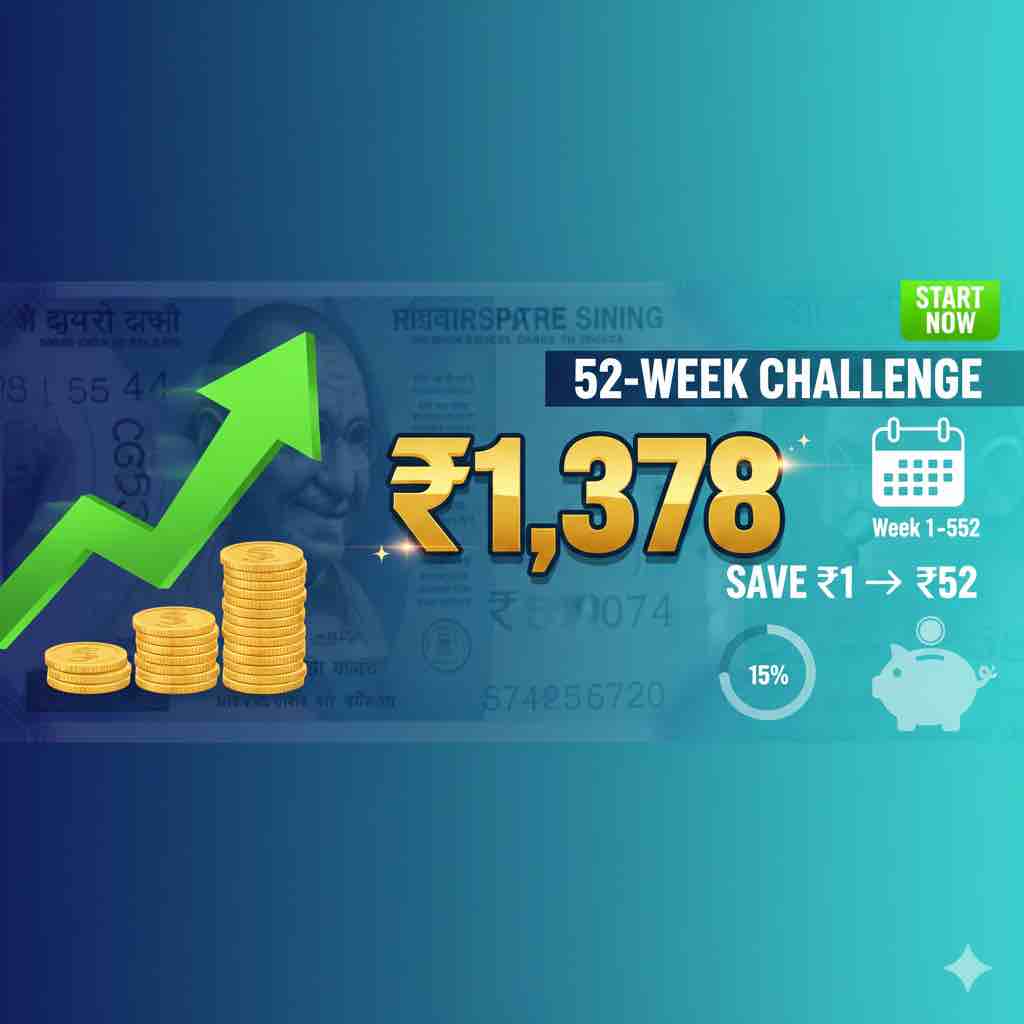
The beauty of the 52-week savings challenge lies in its simplicity—there’s no complicated spreadsheet analysis required, no need for financial expertise, and certainly no massive amount of money to kick things off. In just 52 weeks, you can accumulate ₹1,378 through small, manageable weekly contributions. For many Indian households, this amount can serve as a foundation for an emergency fund, cover unexpected medical expenses, fund a vacation, or jumpstart your investment journey.
But here’s what makes this money-saving challenge truly revolutionary: it’s not just about the final amount. It’s about the financial habits you’ll build along the way and the psychological shift toward disciplined saving that will transform your relationship with money forever.
How the 52-Week Money Challenge Works
The Traditional Forward Approach
The standard 52-week challenge is elegantly straightforward. Here’s exactly how it works:
- Week 1: Save ₹1
- Week 2: Save ₹2
- Week 3: Save ₹3
- Week 4: Save ₹4
- … and so on until …
- Week 52: Save ₹52
By the end of the year, your total savings will be precisely ₹1,378.
The mathematical beauty here is that you’re not just randomly accumulating money—you’re following a proven formula where each week’s contribution increases by exactly one rupee. This means that by mid-year (Week 26), you’ll have saved ₹351, and you’ll be putting away ₹26 per week. By the final quarter, you’ll be saving ₹40, ₹41, ₹42, and upward, creating a satisfying sense of momentum.
Why the Numbers Work Out Perfectly
The calculation is based on a simple arithmetic progression: the sum of all numbers from 1 to 52 equals 1,378. Mathematically, this is expressed as: (52 × 53) ÷ 2 = 1,378. So whether you’re following this challenge in India with rupees or anywhere else in the world, the proportions remain consistent and reliable.
The Reverse Challenge: Save Big First, Finish Light
Now here’s where things get interesting. Many Indians who initially embrace the traditional 52-week savings challenge find themselves struggling by November and December—precisely when holiday shopping, festive season spending, and year-end expenses spike. This is where the reverse challenge becomes a game-changer.
How the Reverse Challenge Works
With the 52-week reverse challenge, you flip the entire structure on its head:
- Week 1: Save ₹52
- Week 2: Save ₹51
- Week 3: Save ₹50
- … decreasing by ₹1 each week until …
- Week 52: Save ₹1
You’ll still end up with the same ₹1,378 in total savings, but the psychological and practical benefits are substantial.
Why the Reverse Method Often Works Better
Behavioral finance research shows that our willpower and motivation are strongest at the beginning of any challenge. When you’re fired up with New Year’s resolutions and fresh determination, you can handle saving ₹52 in the first week. As the year progresses and real life gets in the way—unexpected expenses, medical emergencies, the demands of family—you’re gradually reducing your weekly commitment.
Consider the timing advantage: by October, November, and December—when Diwali celebrations, Christmas shopping, and year-end festivities create spending pressures—you’re only being asked to save ₹10, ₹5, or even ₹1. This makes the challenge feel like it’s working with your natural spending patterns rather than against them.
Adapting the Challenge to Your Income Level
One concern many Indians express is whether ₹1,378 is realistic for their financial situation. The wonderful news? The 52-week challenge is infinitely flexible.
Modified Starting Points for Different Budgets
If ₹1 feels too conservative or if you can comfortably afford more, you can scale the challenge:
Starting with ₹10 per week:
- Week 1: Save ₹10
- Week 2: Save ₹20
- Week 3: Save ₹30
- By Week 52: You’ll save ₹520
- Total savings: ₹13,780
Starting with ₹50 per week:
- Week 1: Save ₹50
- Week 2: Save ₹100
- Week 3: Save ₹150
- By Week 52: You’ll save ₹2,600
- Total savings: ₹68,900
This flexibility means whether you earn ₹20,000 per month or ₹1 lakh, there’s a version of this savings challenge that fits your circumstances. The principle remains identical—consistent, progressive, achievable deposits that compound into meaningful results.
The Psychology Behind Why This Challenge Works
Building Habits, Not Just Savings
Research on behavioral finance reveals something counterintuitive: focusing exclusively on distant financial goals actually reduces your likelihood of success by up to 50%. Why? Because goals feel abstract and far away. Challenges, however, are process-focused. Each week presents a small, concrete, achievable task.
When you complete Week 1 and deposit ₹1, you’ve won. When Week 2 comes and you deposit ₹2, you’ve succeeded again. These small wins accumulate, and your brain begins to associate saving with success rather than deprivation.
Overcoming Psychological Barriers to Saving
Many Indians struggle with saving because they view it as restrictive—taking money away from current enjoyment for an uncertain future benefit. The 52-week challenge reframes this narrative. Instead of “I need to save ₹1,000 this month,” you’re simply playing a game where each week has a clear objective.
The incremental nature also helps overcome the “all or nothing” mentality that derails many savings attempts. Missing one week doesn’t mean failure—it just means you adjust and continue. The progressive increase means you’re gradually training yourself to handle larger amounts, building confidence and financial muscle memory.
Practical Implementation: Starting Your 52-Week Money Challenge
Step 1: Choose Your Format
Decide whether you’ll follow the traditional forward method or the reverse challenge. Ask yourself:
- Choose Forward If: You want early momentum and don’t mind increasing amounts as the year progresses. This works well for salaried professionals who expect consistent income.
- Choose Reverse If: You want to capitalize on your strongest motivation at the beginning or if you anticipate lower income during festive seasons. This suits freelancers, seasonal workers, and those with variable income.
Step 2: Designate a Separate Savings Account
This is crucial. Create a separate bank account—either with your existing bank or through an online banking platform—dedicated exclusively to this money-saving challenge. Don’t mix this money with your regular savings or checking account.
Why does separation matter? Psychologically, it creates a tangible distinction between “challenge money” and regular cash. You’ll feel the satisfaction of watching this dedicated account grow week after week.
Pro tip for Indian savers: Many banks now offer no-frills digital savings accounts with zero maintenance fees and better interest rates. Platforms like Jupiter, Paytm Money, or standard bank apps make transfers instantaneous.
Step 3: Automate Your Weekly Deposits
Automation is the difference between intending to save and actually saving. Set up an automatic transfer from your primary account to your challenge account every Friday or every Monday—whatever day works with your salary cycle.
Most Indian banks now allow you to set recurring transfers through their mobile apps. If your bank doesn’t offer this, create a calendar reminder and manually transfer on the same day each week.
Step 4: Track Your Progress Visually
Print out a simple table showing all 52 weeks, or use a spreadsheet. As you complete each week, mark it off. This visual representation of progress is surprisingly motivating. Watching your target amount creep from ₹1 to ₹26 to ₹52 creates a tangible sense of achievement.
Some people prefer the analog approach—maintaining a physical chart on their refrigerator. Others use apps or spreadsheets. Choose whatever method you’ll actually look at and find encouraging.
Using Your Accumulated Savings Wisely
By Week 52, you’ll have ₹1,378 sitting in your designated account. Now what? This is where your financial goals come into play.
Building Your Emergency Fund
In India, financial experts recommend maintaining an emergency fund covering 3 to 6 months of living expenses. If your monthly expenses are ₹20,000, your target emergency fund should be ₹60,000-₹1,20,000. The ₹1,378 from your challenge serves as an excellent foundation for this critical financial safety net.
Many Indians don’t have any emergency cushion, making them vulnerable to debt when unexpected expenses arise. Your challenge savings is the beginning of protection.
Investing for Growth
If you already have an emergency fund, consider investing your challenge savings. Placing ₹1,378 into a Systematic Investment Plan (SIP) or a high-yield fixed deposit could generate additional returns. Even at conservative interest rates, you’re not just saving—you’re creating money through compound interest.
Dedicated Goal Funding
Label your challenge savings for something specific:
- Vacation fund: Use it for the trip you’ve been postponing
- Festive season buffer: Create breathing room during Diwali or Christmas spending
- Medical contingency: Ensure you have funds for health emergencies
- Educational investment: Apply it toward a course or skill development
The specificity of purpose keeps you motivated and ensures the money doesn’t get absorbed into regular expenses.
Overcoming Common Obstacles
What Happens When Week 40 Arrives and ₹40 Feels Impossible?
Life happens. Unexpected medical bills, car repairs, or reduced income can make ₹40 feel unmanageable in a particular week. Here’s the reality: the challenge isn’t ruined by missing one week.
Option 1 – Catch-up: If Week 40 is difficult, save ₹40 the following week and maintain your schedule.
Option 2 – Adjust: If ₹40 is genuinely unaffordable, save what you can. ₹20 is infinitely better than ₹0.
Option 3 – Switch approaches: Move to the reverse challenge mid-year if you’re struggling with increasing amounts.
The goal isn’t perfection—it’s progress. Even if you complete the challenge with ₹1,200 instead of ₹1,378, you’ve still accomplished something remarkable: you’ve built a savings habit and accumulated meaningful money through consistent effort.
Preventing the “Holiday Spending Cliff”
November and December derail countless savers. Combat this by:
- Front-loading in Q1 & Q2: Build a buffer in the first half of the year
- Reverse challenging: As mentioned, this method naturally accommodates holiday spending
- Combining strategies: Do a no-spend week during your higher-deposit weeks to double your progress
- Family accountability: Tell relatives you’re doing a challenge and ask for their support
Taking the Challenge Beyond 52 Weeks
Completion of your first 52-week cycle isn’t an ending—it’s a beginning. Once you’ve proven to yourself that you can consistently save, several pathways open:
Starting a New Challenge
Begin another cycle with an increased increment. Instead of ₹1, start with ₹2. Instead of ₹10, start with ₹15. Your savings habit is now ingrained; you’re simply scaling it up.
Combining Multiple Challenges
Some committed savers run parallel challenges simultaneously. Perhaps you do the traditional 52-week challenge while also maintaining a ₹500 weekly envelope challenge. This diversity prevents monotony while accelerating your wealth-building.
Investing Your Success Capital
With ₹1,378 accumulated from your first challenge, plus additional savings from employment, you now have capital to invest. Research mutual funds, consider opening a recurring deposit, or explore government savings schemes like the Public Provident Fund (PPF)—all designed for Indian savers.
The Bigger Picture: How This Challenge Fits Into Comprehensive Financial Health
The 52-week challenge doesn’t exist in isolation. It’s one tool within a broader framework of financial discipline. Simultaneously, you should:
Track expenses: Know where your money goes. Use apps like Money Manager or Walrus to categorize spending.
Create a basic budget: Allocate income across needs, wants, and savings. The 50/30/20 framework works well in India—50% needs, 30% wants, 20% savings and debt repayment.
Build financial goals: Whether it’s a house down payment, child’s education, or retirement, frame your challenge within these larger objectives.
Develop investing knowledge: ₹1,378 is starter capital. Learn about SIPs, fixed deposits, stocks, and other vehicles to make your money work harder.
Conclusion: Your 52-Week Journey Begins Now
The 52-week money challenge for Indians represents something far more valuable than ₹1,378. It’s a concrete manifestation of your commitment to financial independence, a declaration that you can change your relationship with money through sustained effort, and proof that meaningful achievement doesn’t require dramatic gestures—just consistent, small steps.
Whether you choose the traditional forward approach or the reverse challenge, whether you’re saving ₹1 or ₹100 incrementally, you’re joining thousands of Indians who’ve discovered that financial transformation is within reach. Not through lottery wins or inheritance, but through the simple power of habit and consistency.
Your Week 1 awaits. Open that dedicated bank account. Make your first deposit. Mark Week 1 complete. And then, next week, do it again.
By Year 52, you won’t just have ₹1,378 in savings. You’ll have fundamentally rewired your financial mindset. You’ll have experienced the compounding power of consistency. And you’ll be ready to scale up, invest, and build the financial future you deserve.
The question isn’t whether you can save ₹1 this week. The real question is: are you ready to transform your financial life?
Start today. The best time to plant a money tree was years ago. The second-best time is right now.
- The 2026 Nationwide 3 Days Bank Strike: Why India’s Banking Backbone is Breaking
 Discover the root causes of the 2026 nationwide bank strike. Explore the struggle for 5-day banking, fair incentives, and why a Uniform Banking Standard is urgently needed to protect the dignity and job security of all bank employees.
 - UPI MDR 2026: Is UPI Still Free? Here’s the Real Answer
 A simple guide to the new UPI MDR rules effective October 15, 2026 — who pays the 0.4% merchant charge, who doesn’t, and why UPI stays free for customers.
 - Sole Proprietorship in India: Do You Need Registration? Documents & Benefits Explained
 Learn how to start a sole proprietorship firm in India, understand registration requirements, benefits, GST and Udyam registration, and discover the essential documents needed to open a business bank account. A simple beginner’s guide to launching your business confidently and correctly.
 - What is HUF? The Ancient Rule Letting Modern Families Unlock Double Tax Benefits
 Want to legally save on income tax? Discover how a Hindu Undivided Family (HUF) protects wealth and maximizes tax benefits. Explore our complete guide on HUF eligibility, the 2005 amendment, and step-by-step instructions to open an HUF bank account.
 - Exposed by RTI: Banks Recover 74% from Small Borrowers, Just 14% from Giants
 Shocking RTI data reveals a massive banking divide: banks recover 74% of bad loans from small borrowers but only 14.5% from corporate giants. Discover why ordinary citizens face harsh recovery agents while large defaulters enjoy massive loan write-offs.
 - Is Your Online MBA Tax-Deductible? The 2026 Blueprint to Upskill and Save Lakhs on Interest
 Pursuing an online MBA? Discover how working professionals can claim unlimited tax benefits on education loan interest under Section 80E. Learn the eligibility rules, calculation methods, and smart ways to maximize your tax savings while upgrading your career.
 - Budget 2026 Predictions: Top 5 Expectations Likely to Become Reality
 Budget 2026 is around the corner! Discover our top 5 predictions—like tax relief hikes and railway boosts—that are most likely to happen. Get ahead with smart insights for your finances.
 - Budget 2026: Why Your Marriage Certificate Could Be Your Biggest Tax-Saving Tool This Year
 Budget 2026 eyes joint taxation for couples—pool incomes, slash taxes by 20-30%! Save lakhs with optional filing. Explore how it beats income tax slabs, boosts tax savings, and what it means for your family finances. Will FM approve? Read now!
 - Sunita Williams’ Secret: Astronaut Mindset That Builds Crores via SIP Investing
 Discover Sunita Williams’ astronaut mindset for wealth building: Solve crises “one bite at a time” like mutual fund SIP investing. Learn disciplined saving, risk pivots, and best mutual funds India strategies from her 27-year NASA career.
 - HDFC Bank Q3 Surprise: Profit Jumps 11.5% – Why Experts Call It a ‘Screaming Buy’ at ₹930
 HDFC Bank’s Q3 FY26 results shine: 11.5% profit surge to ₹18,653 Cr, GNPA at 1.24%, deposits up 11.5%. Beats estimates amid deposit wars—strong buy for 2026? Stock eyes ₹1,000 breakout.