
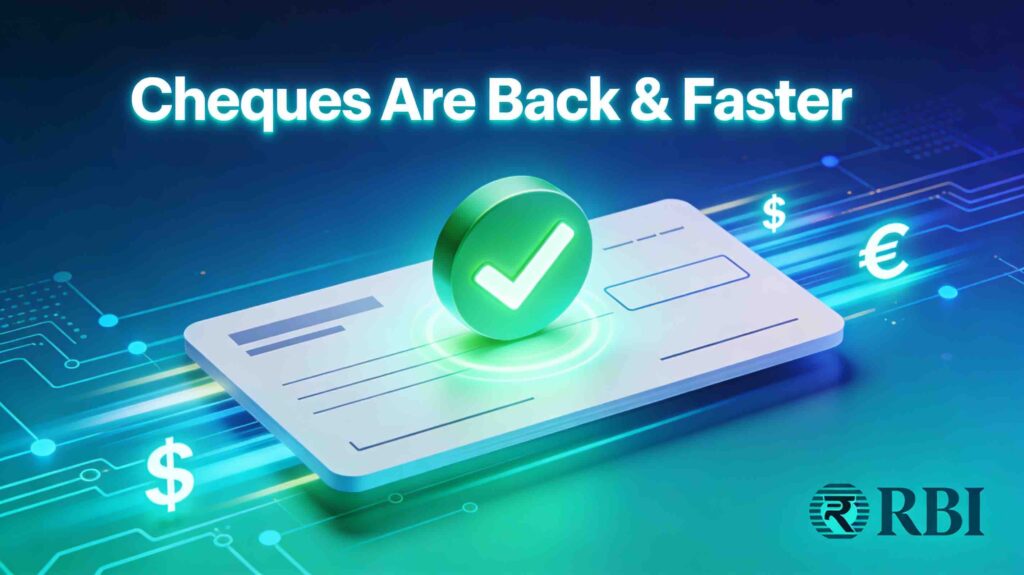
Remember when people said cheques were obsolete? Well, turns out they’re not going anywhere—they’re just getting a major speed boost. Just as India’s financial infrastructure continues evolving, the Reserve Bank of India has been quietly revolutionizing how cheques work. While there’s been a recent plot twist with the postponement of Phase 2, the real-time cheque clearing system that kicked off in October 2025 is already transforming how money moves through the banking system.
Let’s dive into what this means for you, whether you’re a small business owner, freelancer, or someone who still relies on the humble cheque for important transactions.
The Cheque Clearing Problem Nobody Talks About
Imagine this: You deposit a cheque on Monday morning. Your customer wrote it on Friday. But the money doesn’t show up in your account until Wednesday—maybe Thursday if you’re unlucky. That two-to-three-day wait has been standard practice in India for years, thanks to the traditional batch-based cheque clearing system.
For businesses operating on tight cash flows, those extra days can be painful. You’re waiting for funds that are technically already committed. Meanwhile, your bank processes cheques in fixed batches at set times during the day, which means if you deposit a cheque at 4:45 PM, it waits until the next business day to even enter the system.
It’s an outdated process that belonged to an era of physical document movement and manual verification. So when the RBI announced a fundamental shift to continuous, real-time cheque clearing, it was genuinely significant news.
How the New Cheque Clearing System Works
Starting October 4, 2025, India transitioned from the traditional batch-based cheque processing to what’s called “continuous clearing and settlement on realisation.” Here’s what that means in practical terms.
The Old Way (Still Fresh in Memory)
Under the old batch system, cheques were processed at fixed times. If multiple cheques arrived at different times throughout the day, they’d all wait for the next batch window. Settlement happened once daily, meaning you’d get your money the next business day if you were lucky—often it took longer.
The New Way (Already Happening)
Now, cheques are processed continuously throughout the business day. When you deposit a cheque between 10 AM and 4 PM, it gets scanned and sent to the clearing house immediately. There’s no more waiting for a “batch slot.” The cheque image and associated data move through the system in real-time.
The drawee bank (the bank where the cheque writer has their account) receives the cheque image instantly and has until 7 PM the same day to confirm whether the cheque should be honored or rejected. Here’s where it gets interesting: if the bank doesn’t respond by 7 PM, the cheque is automatically deemed approved and sent for settlement. This auto-approval feature prevents cheques from getting stuck due to processing delays.
Once approved, settlement happens every hour starting from 11 AM. This means funds can reach your account within hours of deposit—not days.
The Plot Twist: What Happened to Phase 2?
Here’s where things got interesting. The RBI had originally planned a Phase 2 rollout for January 3, 2026, which would have reduced the bank confirmation window from the entire day to just three hours. Imagine: a cheque received at 11 AM would need to be confirmed by 1 PM. Full processing would be even faster.
But on December 24, 2025, the RBI announced that Phase 2 has been postponed indefinitely. The statement cited the need to “allow more time for banks to streamline their operation.”
What does this mean for you? Honestly, not much changes in your daily life. Phase 1, which is currently active, already delivers dramatic improvements over the old system. Phase 2 would have been an optimization—making an already-fast system even faster. But the foundation has shifted, and that’s what matters.
The Real Benefits You’re Actually Getting Right Now
Don’t let the Phase 2 postponement overshadow what’s already happening. The Phase 1 system that’s been live since October is genuinely transformative compared to what came before.
1. Same-Day Processing is Real
For most cheques, you’ll see funds in your account on the same day you deposit them. Not the next business day—the same day. If you deposit at 11 AM, you could have the money by 3 PM if the bank confirms quickly, or guaranteed by 8 PM even if they use the full confirmation window. This is a massive shift from the old T+1 or T+2 timeline.
2. No More Batch Waiting
Your cheque doesn’t wait for a “clearing window.” It’s processed the moment it arrives. This continuous clearing approach means you’re not penalized for depositing late in the business day. A cheque deposited at 3:50 PM gets the same treatment as one deposited at 10:05 AM.
3. The Auto-Approval Safety Net
If the drawee bank is slow or experiences technical issues, your cheque doesn’t get stuck. It’s automatically approved and sent for settlement. This removes a source of anxiety and delay that plagued the old system.
4. Better for Business Cash Flow
For small business owners and freelancers, this is game-changing. You can rely on cheques clearing within hours, which makes cash flow planning more predictable. You know roughly when the money will hit your account, not three days from now.
5. Nationwide Consistency
The old system had three separate clearing grids (Delhi, Mumbai, and Chennai), which meant some regions had different processing rules. The new continuous clearing system is uniform across the country. Same rules, same speed, regardless of where you bank.
Why Cheques Still Matter in a Digital India
At this point, you might be wondering: if digital payments like UPI and NEFT exist, why are we even upgrading the cheque system?
Fair question. The reality is that cheques still account for a significant portion of high-value transactions in India. Property deals, large business settlements, and legal agreements often require cheques due to regulatory conventions and the paper trail they create. Plus, they serve as proof of payment in ways digital transactions sometimes don’t for certain transactions and sectors.
According to recent data, while cheque usage has declined sharply—now representing less than 3% of all payment transactions—they remain deeply embedded in India’s financial ecosystem for specific use cases. The RBI understands this and chose to modernize the cheque system rather than abandon it.
This upgrade ensures that cheques evolve alongside digital payments rather than becoming obsolete overnight. It’s a bridge between legacy systems and modern fintech infrastructure.
What You Need to Do Differently (Spoiler: Not Much)
From a customer perspective, the good news is that the new real-time cheque clearing system requires almost no behavioral change on your part.
Best Practices:
- Deposit cheques during operating hours (9 AM – 3 PM presentation window). If you need to deposit outside these hours, you’ll have to wait until the next business day anyway.
- Maintain account balance. Since cheques clear faster, ensure your account has sufficient funds when issuing cheques. The money will be debited sooner than it used to be.
- For high-value cheques (above ₹5 lakh), use “Positive Pay”—a security feature where you register the cheque details with your bank to prevent unauthorized alterations. It’s now mandatory for these amounts and adds an extra layer of protection.
- Verify cheque details. As always, ensure the date, payee name, amount, and signature are correct. A faster system still rejects cheques with errors.
The Bigger Picture: India’s Digital Payment Evolution
The continuous cheque clearing system is part of a larger story about India’s financial infrastructure modernization. While the RBI is accelerating cheque processing, the broader shift is toward digital payments. UPI crossed 45 billion transactions annually, NEFT and RTGS handle massive volumes, and digital wallets are becoming mainstream.
What the RBI is doing with cheques is ensuring they don’t become a bottleneck in this digital transition. Rather than let cheques decay within an obsolete system, they’re modernizing them to operate at speeds that rival digital payment methods.
This approach reflects practical realism: India’s economy is large and diverse. Not every sector, region, or transaction type is ready for complete digitalization. By improving the cheque system, the RBI is keeping an important payment channel relevant while investments in digital infrastructure continue.
Looking Ahead: What About Phase 2?
The RBI hasn’t abandoned Phase 2—it’s merely paused it. The three-hour confirmation window that Phase 2 would have introduced is still the plan. The regulator simply recognized that banks needed more time to fully optimize their systems for that level of speed.
When Phase 2 eventually launches (no timeline has been announced), you’ll see another jump in speed, with confirmations happening almost instantly rather than requiring the full business day. For now, the Phase 1 system is delivering substantial improvements, and that’s where the real impact is.
The Bottom Line
Cheques aren’t dead. They’re faster than they’ve ever been in India. The new real-time cheque clearing system that came into effect in October 2025 has fundamentally changed how long it takes for cheques to clear—from days to hours, in most cases.
Whether you’re a small business owner tired of waiting three days to access funds, a freelancer juggling multiple client payments, or someone in an industry where cheques remain standard practice, you’re benefiting from this upgrade right now.
The postponement of Phase 2 is a minor footnote in a much bigger story. The real transformation already happened when the RBI switched from batch-based to continuous clearing. That change is live, it’s working, and it’s making the Indian financial system faster, more efficient, and more practical for the diverse needs of an increasingly digital but still-hybrid economy.
Next time someone tells you cheques are obsolete, you’ll know the real story: they’re not going anywhere, and they just got a lot faster.
- The 2026 Nationwide 3 Days Bank Strike: Why India’s Banking Backbone is Breaking
 Discover the root causes of the 2026 nationwide bank strike. Explore the struggle for 5-day banking, fair incentives, and why a Uniform Banking Standard is urgently needed to protect the dignity and job security of all bank employees.
 - UPI MDR 2026: Is UPI Still Free? Here’s the Real Answer
 A simple guide to the new UPI MDR rules effective October 15, 2026 — who pays the 0.4% merchant charge, who doesn’t, and why UPI stays free for customers.
 - Sole Proprietorship in India: Do You Need Registration? Documents & Benefits Explained
 Learn how to start a sole proprietorship firm in India, understand registration requirements, benefits, GST and Udyam registration, and discover the essential documents needed to open a business bank account. A simple beginner’s guide to launching your business confidently and correctly.
 - What is HUF? The Ancient Rule Letting Modern Families Unlock Double Tax Benefits
 Want to legally save on income tax? Discover how a Hindu Undivided Family (HUF) protects wealth and maximizes tax benefits. Explore our complete guide on HUF eligibility, the 2005 amendment, and step-by-step instructions to open an HUF bank account.
 - Exposed by RTI: Banks Recover 74% from Small Borrowers, Just 14% from Giants
 Shocking RTI data reveals a massive banking divide: banks recover 74% of bad loans from small borrowers but only 14.5% from corporate giants. Discover why ordinary citizens face harsh recovery agents while large defaulters enjoy massive loan write-offs.
 - Is Your Online MBA Tax-Deductible? The 2026 Blueprint to Upskill and Save Lakhs on Interest
 Pursuing an online MBA? Discover how working professionals can claim unlimited tax benefits on education loan interest under Section 80E. Learn the eligibility rules, calculation methods, and smart ways to maximize your tax savings while upgrading your career.
 - Budget 2026 Predictions: Top 5 Expectations Likely to Become Reality
 Budget 2026 is around the corner! Discover our top 5 predictions—like tax relief hikes and railway boosts—that are most likely to happen. Get ahead with smart insights for your finances.
 - Budget 2026: Why Your Marriage Certificate Could Be Your Biggest Tax-Saving Tool This Year
 Budget 2026 eyes joint taxation for couples—pool incomes, slash taxes by 20-30%! Save lakhs with optional filing. Explore how it beats income tax slabs, boosts tax savings, and what it means for your family finances. Will FM approve? Read now!
 - Sunita Williams’ Secret: Astronaut Mindset That Builds Crores via SIP Investing
 Discover Sunita Williams’ astronaut mindset for wealth building: Solve crises “one bite at a time” like mutual fund SIP investing. Learn disciplined saving, risk pivots, and best mutual funds India strategies from her 27-year NASA career.
 - HDFC Bank Q3 Surprise: Profit Jumps 11.5% – Why Experts Call It a ‘Screaming Buy’ at ₹930
 HDFC Bank’s Q3 FY26 results shine: 11.5% profit surge to ₹18,653 Cr, GNPA at 1.24%, deposits up 11.5%. Beats estimates amid deposit wars—strong buy for 2026? Stock eyes ₹1,000 breakout.