
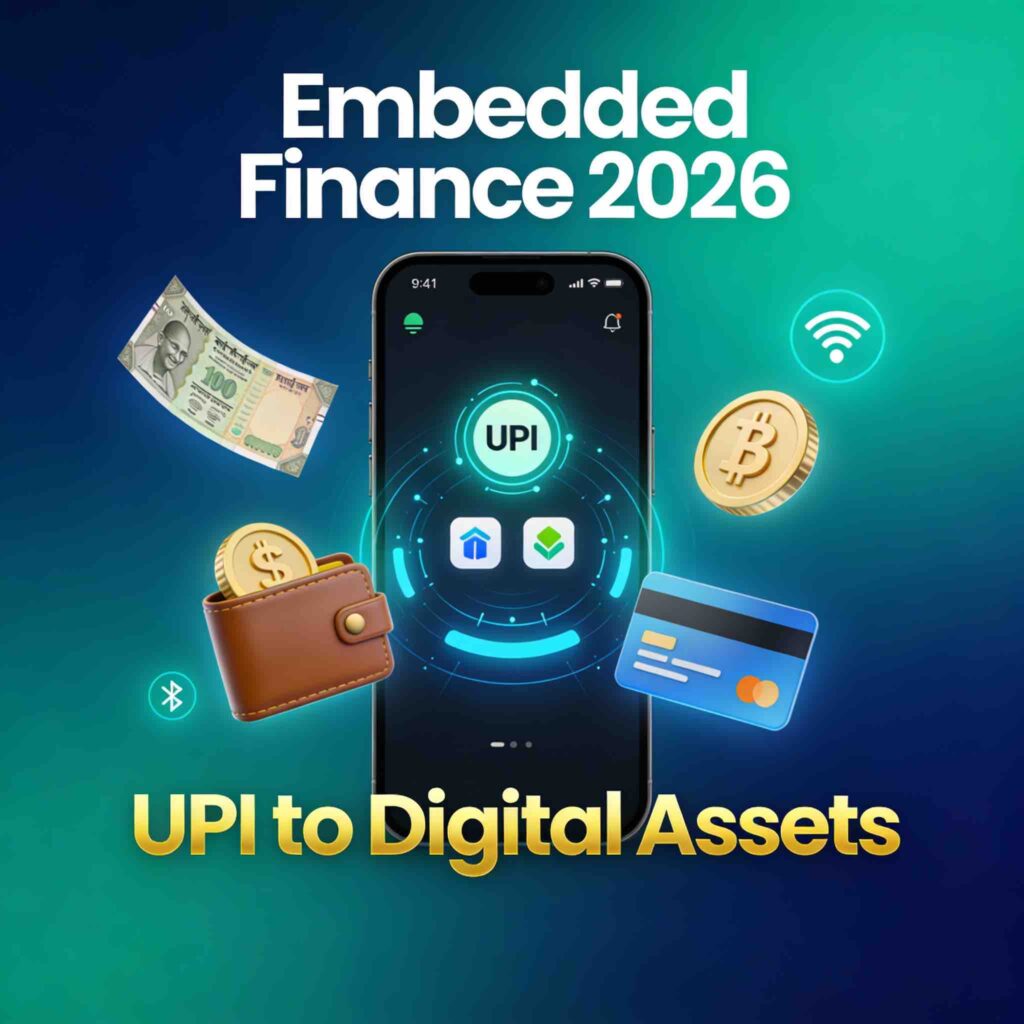
Five years ago, if you wanted a loan, you’d visit a bank, fill out endless forms, and wait weeks for approval. Today? Your Flipkart app offers you instant credit while you’re checking out a pair of shoes. Your Ola ride can include travel insurance without you asking for it. Your mutual fund investment now sits inside your digital wallet alongside your daily payments. This isn’t science fiction—this is embedded finance, and it’s quietly reshaping how Indians handle money in 2026.
But here’s the thing: most people don’t realize what’s happening. You’re using embedded finance without knowing its name. And understanding it matters, because it’s about to become as normal as UPI payments.
What Actually Is Embedded Finance?
Let’s keep it simple. Embedded finance means financial services—credit, insurance, investments, payments—woven directly into apps and platforms you already use. Instead of “here’s your shopping app, and separately, here’s a finance app,” everything blends together seamlessly.
Think about it this way: traditionally, finance was separate. You visited a bank for loans, an insurance agent for policies, an investment app for stocks. Today, all of that can happen within your favorite e-commerce platform, your ride-sharing app, or even your digital wallet.
The market is explosive. India’s embedded finance sector, valued at approximately $24 billion in 2025, is growing at a staggering rate. Projections suggest it could reach nearly $34 billion by 2030, with some analysts predicting it could hit $28.6 billion by 2029 at a 45% annual growth rate. To put it in perspective, the broader BNPL (Buy Now, Pay Later) market alone is expected to grow from $30.88 billion in 2025 to over $78 billion by 2030.
Why the Sudden Explosion?
Three things collided perfectly in India:
UPI Created the Foundation. India’s Unified Payments Interface (UPI) isn’t just a payment system—it’s infrastructure. Today, UPI handles 650 million transactions daily (as of mid-2025), which actually exceeds Visa’s global daily transaction count. It powers 85% of all digital transactions in India. With such a massive, trusted, real-time payment system in place, building financial services on top became possible.
900 Million Internet Users Changed the Game. By 2025, India has nearly 900 million internet users. Rural and semi-urban areas are the fastest-growing segments. These aren’t tech-savvy, branch-visiting types—they’re smartphone-first. They need finance that comes to them, not finance they have to hunt for.
The RBI and Regulators Opened the Door. Rules around digital lending, open banking, and data sharing have become clearer. Banks can now partner with fintech platforms. Insurers can bundle policies with purchases. Lenders can access alternative credit data. The regulatory sandbox is mature enough to support innovation without becoming a Wild West.
Five Big Trends Shaping 2026
1. Embedded Credit (BNPL) Becoming Your Default.
Buy Now, Pay Later has moved beyond e-commerce. It’s now in travel bookings, healthcare payments, and even utility bill settlements. Flipkart, Amazon, Ola—they all offer instant EMI options. But this year, it’s becoming smarter. AI-powered underwriting means approvals happen in seconds. And small businesses are using embedded lending for working capital, not just consumer purchases.
2. Insurance Bundling Into Everything.
Ever bought a flight ticket? Soon, travel insurance won’t be an afterthought—it’ll auto-bundle. Booked a doctor’s appointment? Health micro-insurance could be embedded right there. The insurance industry calls this the “point of need” moment, and it’s finally here.
3. UPI Goes Beyond Payments.
UPI Lite, UPI Credit, recurring payments (autopay for your gym subscription)—these aren’t just features, they’re behavioral shifts. By 2026, UPI is becoming your financial backbone, not just your payment tool. Even investments through digital SIPs (Systematic Investment Plans) can now happen through UPI AutoPay, meaning your mutual fund investments are just a tap away.
4. Digital Assets & Crypto Integration.
This is the big one nobody talks about enough. While crypto remains debated, the infrastructure to handle digital assets—including cryptocurrencies and tokenized securities—is being integrated into mainstream financial platforms. When digital assets become tradeable through your regular banking app (with proper RBI guardrails), embedded finance stops being just about credit and insurance. It becomes about wealth management.
5. Your Data Becomes Your Credit Score.
Forget traditional credit history. Platforms now use your transaction data, purchase patterns, and repayment history within their ecosystem. A Zerodha trader has different credit data than an Ola driver. An Amazon shopper has different patterns than a Flipkart user. AI models are custom-building credit scores for you based on your specific behavior, making credit more inclusive.
Real Examples You’re Already Using
Amazon Pay Offers Instant Credit: When you shop on Amazon, you can split payments into EMIs—no separate app, no extra forms. That’s embedded lending.
Paytm Money Offers Mutual Funds: Open Paytm’s wallet app, and you can now invest in SIPs directly. Your payments and investments live in one place.
Ola Book Travel Insurance: When you book an Ola ride to the airport, insurance is optional but built-in. That’s embedded insurance.
PhonePe’s Banking Features: PhonePe isn’t just a payment app anymore. It offers loans, insurance, and investment products through partnerships with regulated lenders.
AssetPlus SIP AutoPay: Investors can now set up recurring mutual fund investments through UPI, making wealth building as easy as a daily payment.
Why This Matters for Regular Indians
Let’s be honest—traditional banking is slow. Visiting a branch, waiting in queues, filing forms—it’s 20th-century friction in a 21st-century world. Embedded finance eliminates that.
For a farmer buying seeds, embedded credit means instant working capital without a bank visit. For a student, embedded insurance in their travel app means peace of mind without hunting for policies. For a daily wage worker, embedded investment options mean they can invest small amounts within apps they already use daily.
But there’s a flip side. Trust and security are critical. With more financial services happening in fewer apps, the stakes are higher. Fraud, mis-selling, and data privacy become crucial. The RBI knows this, which is why regulations are tightening.
The 2026 Outlook
By year-end 2026, embedded finance won’t feel “new.” It’ll feel normal. Your e-commerce platform will offer credit. Your ride-app will bundle insurance. Your payment app will manage investments. Your digital wallet will be your financial hub.
The shift from “UPI to digital assets” isn’t hyperbole—it’s the natural evolution of financial services in India. UPI proved that real-time, digital-first finance could work at scale. Now, everything else is being built on top.
The India that emerges in 2026 won’t abandon banks or traditional finance. Instead, finance becomes ambient—it’s there when you need it, where you need it, in the app you’re already using. That’s the real revolution.
The Bottom Line
You don’t need to understand blockchain, APIs, or regulatory frameworks to benefit from embedded finance. You just need to recognize what’s happening: financial services are becoming contextual, instant, and seamlessly woven into your daily digital life.
UPI taught India that payments could be instant. Embedded finance is about to teach us that all financial services can be instant too. The explosion isn’t coming—it’s already here. By 2026, you’ll be living in a financial system you barely notice, because it works exactly when and how you need it.
The question isn’t whether embedded finance will explode in 2026. The question is: are you ready to use it?
- The 2026 Nationwide 3 Days Bank Strike: Why India’s Banking Backbone is Breaking
 Discover the root causes of the 2026 nationwide bank strike. Explore the struggle for 5-day banking, fair incentives, and why a Uniform Banking Standard is urgently needed to protect the dignity and job security of all bank employees.
 - UPI MDR 2026: Is UPI Still Free? Here’s the Real Answer
 A simple guide to the new UPI MDR rules effective October 15, 2026 — who pays the 0.4% merchant charge, who doesn’t, and why UPI stays free for customers.
 - Sole Proprietorship in India: Do You Need Registration? Documents & Benefits Explained
 Learn how to start a sole proprietorship firm in India, understand registration requirements, benefits, GST and Udyam registration, and discover the essential documents needed to open a business bank account. A simple beginner’s guide to launching your business confidently and correctly.
 - What is HUF? The Ancient Rule Letting Modern Families Unlock Double Tax Benefits
 Want to legally save on income tax? Discover how a Hindu Undivided Family (HUF) protects wealth and maximizes tax benefits. Explore our complete guide on HUF eligibility, the 2005 amendment, and step-by-step instructions to open an HUF bank account.
 - Exposed by RTI: Banks Recover 74% from Small Borrowers, Just 14% from Giants
 Shocking RTI data reveals a massive banking divide: banks recover 74% of bad loans from small borrowers but only 14.5% from corporate giants. Discover why ordinary citizens face harsh recovery agents while large defaulters enjoy massive loan write-offs.
 - Is Your Online MBA Tax-Deductible? The 2026 Blueprint to Upskill and Save Lakhs on Interest
 Pursuing an online MBA? Discover how working professionals can claim unlimited tax benefits on education loan interest under Section 80E. Learn the eligibility rules, calculation methods, and smart ways to maximize your tax savings while upgrading your career.
 - Budget 2026 Predictions: Top 5 Expectations Likely to Become Reality
 Budget 2026 is around the corner! Discover our top 5 predictions—like tax relief hikes and railway boosts—that are most likely to happen. Get ahead with smart insights for your finances.
 - Budget 2026: Why Your Marriage Certificate Could Be Your Biggest Tax-Saving Tool This Year
 Budget 2026 eyes joint taxation for couples—pool incomes, slash taxes by 20-30%! Save lakhs with optional filing. Explore how it beats income tax slabs, boosts tax savings, and what it means for your family finances. Will FM approve? Read now!
 - Sunita Williams’ Secret: Astronaut Mindset That Builds Crores via SIP Investing
 Discover Sunita Williams’ astronaut mindset for wealth building: Solve crises “one bite at a time” like mutual fund SIP investing. Learn disciplined saving, risk pivots, and best mutual funds India strategies from her 27-year NASA career.
 - HDFC Bank Q3 Surprise: Profit Jumps 11.5% – Why Experts Call It a ‘Screaming Buy’ at ₹930
 HDFC Bank’s Q3 FY26 results shine: 11.5% profit surge to ₹18,653 Cr, GNPA at 1.24%, deposits up 11.5%. Beats estimates amid deposit wars—strong buy for 2026? Stock eyes ₹1,000 breakout.