
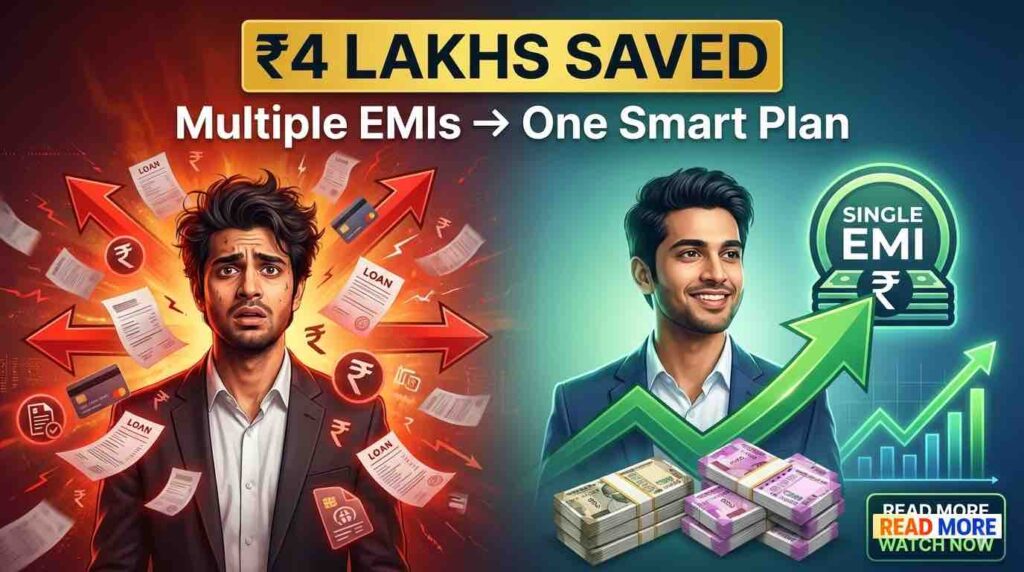
Are you constantly juggling different loan EMI due dates each month? Does managing multiple personal loans, credit cards, and other debts feel like a never-ending financial puzzle? If so, you’re not alone. Thousands of Indian urban professionals face this exact challenge, and it’s costing them significantly more in interest payments than necessary.
The burden of multiple EMIs is particularly acute for urban youth—young professionals, entrepreneurs, and students who’ve taken on various debts for education, lifestyle, and business needs. What started as manageable monthly obligations often spirals into a stressful financial situation where one missed payment can trigger a domino effect of penalties, credit score damage, and heightened anxiety.
But here’s the good news: debt consolidation strategy offers a proven, elegant solution to this complex problem. By converting multiple EMIs into one smart plan, you can dramatically simplify your finances, reduce overall interest costs, and regain complete control of your money. This comprehensive guide walks you through everything you need to know about consolidating your debts strategically.
Understanding Debt Consolidation: What It Actually Means
Before diving into the strategy, let’s clarify what debt consolidation loan actually does. In simple terms, it’s the process of taking out a new loan to pay off all your existing debts—whether that’s personal loans, credit cards, consumer durable loans, or any combination. Instead of making separate payments to multiple creditors with different due dates and interest rates, you make one single EMI payment monthly.
Think of it as financial housekeeping. Imagine you’re paying ₹5,000 to one lender, ₹3,200 to another, ₹2,800 to a third, and ₹1,500 in credit card dues—that’s four different due dates, four different interest rates, and enormous mental overhead. With EMI consolidation, all these become a single manageable payment, typically at a lower overall interest rate.
Why Indian Urban Youth Faces Unique Debt Pressure
The debt landscape for Indian young professionals has fundamentally shifted over the past decade. Unlike previous generations, today’s urban workforce encounters debt through multiple channels simultaneously:
Educational Loans: Whether it’s MBA programs, professional certifications, or skill-development courses, education-related debt has become mainstream. The average professional carries ₹8-15 lakh in educational obligations.
Lifestyle and Consumer EMIs: Smartphones, laptops, two-wheelers, and home furnishings are increasingly purchased through EMI schemes. What was once a luxury is now normalized, but it fragments your monthly obligations considerably.
Home Loan Commitments: The dream of owning a home comes with a 15-20 year financial commitment, creating the largest single EMI in most budgets.
Credit Card Balances: The convenience of credit cards often leads to accumulated balances, particularly among younger borrowers who haven’t yet developed systematic repayment discipline.
This multi-layered debt structure creates what financial experts call “debt fatigue”—the psychological and financial exhaustion of tracking multiple obligations. The solution? Strategic debt consolidation, which transforms chaos into clarity.
The Real Numbers: Why Debt Consolidation Makes Financial Sense
Let’s work through a practical scenario that mirrors thousands of real situations:
Suppose Rajesh, a 32-year-old IT professional in Bangalore, has three outstanding debts:
- Personal Loan: ₹3,00,000 at 14% interest (36-month tenure) = ₹10,240 monthly EMI
- Credit Card Balance: ₹1,50,000 at 24% interest (rotating balance)
- Two-wheeler Loan: ₹1,00,000 at 16% interest (24 months) = ₹4,750 monthly EMI
Total current debt: ₹5,50,000
Total current monthly EMI: Approximately ₹18,000+ (including credit card minimum payments)
Combined interest rate average: 18%+
Now, if Rajesh applies for a personal loan for debt consolidation at 12% interest for 60 months:
- New consolidated loan amount: ₹5,50,000
- New monthly EMI: Approximately ₹12,320
- Total monthly savings: ₹5,680
Over 60 months, Rajesh saves approximately ₹3,40,800 in total payments, not including the psychological relief of a single due date and lender.
How Debt Consolidation Loans Work in Practice
The process of consolidating your debts is surprisingly straightforward, though it requires careful planning. Here’s the step-by-step approach:
Step 1: Comprehensive Debt Audit
Begin by listing every single debt obligation. Include the outstanding amount, current interest rate, remaining tenure, and monthly EMI for each. This audit creates your financial baseline and helps identify which debts are most expensive.
Step 2: Calculate Your Total Debt Burden
Add up all outstanding amounts. This figure determines your debt consolidation loan amount, though remember that lenders may not finance 100% of your request if your income doesn’t support it.
Step 3: Evaluate Your Credit Score
Most lenders require a credit score of 700+, though some flexible lenders work with scores as low as 650. Your credit score directly affects the interest rate you’ll receive—a 750+ score can secure rates starting at 10.49%, while lower scores might face 14-18% rates.
This is why maintaining payment discipline matters enormously. If your score is below par, consider waiting 3-6 months, making all payments on time, and reducing credit card utilization before applying.
Step 4: Compare Lender Options
The personal loan for debt consolidation market in India has expanded significantly. Compare offerings from:
- Traditional banks (SBI, HDFC, ICICI) offering 10.49%-14% rates
- NBFCs (Bajaj Finserv, IDFC First, Kotak) offering 10.99%-18% rates
- Digital lenders providing flexible approval processes
Step 5: Submit Your Application
Most lenders now offer fully digital applications, with approval within 24-48 hours. You’ll typically need:
- Identity proof (Aadhaar, PAN)
- Income proof (salary slips, IT returns)
- Address proof
- Bank statements for last 3 months
- Existing loan statements and NOC letters
Step 6: Use Funds to Clear Existing Debts
Once approved and disbursed, use the funds to pay off all existing loans immediately. Lenders often disburse directly to creditors or provide clear instructions for repayment.
Step 7: Repay Your Consolidated Loan
You now make a single monthly EMI payment—simpler, predictable, and typically cheaper than your combined previous obligations.
Key Benefits of Converting Multiple EMIs Into One Smart Plan
Beyond the financial savings, debt consolidation strategy offers multiple advantages that ripple through your entire financial life:
1. Simplified Finances and Reduced Stress
Tracking multiple due dates, reminders, and different creditors creates genuine psychological pressure. A single EMI eliminates this complexity. You remember one date, manage one account, and deal with one lender. This simplification is invaluable for mental health and financial discipline.
2. Lower Overall Interest Costs
Credit cards typically charge 20-24% interest, while personal loans average 12-16%. Consolidating high-interest credit card debt into a debt consolidation loan at lower rates creates substantial savings, especially over extended tenures.
3. Improved Credit Score
Counterintuitive as it sounds, taking a new loan can actually improve your credit score—if managed properly. Here’s why: your credit score depends heavily on credit utilization ratio (the percentage of available credit you’re using). When you consolidate credit card debt into a personal loan, your credit card balances drop significantly, lowering your utilization ratio. This improvement can boost your score by 50-100 points over 3-6 months.
4. Fixed Repayment Timeline
Multiple loans have different tenure structures. Consolidation provides a clear endpoint—you know exactly when you’ll be debt-free. This certainty enables better long-term financial planning.
5. Flexible Repayment Terms
Modern debt consolidation loans offer tenure flexibility from 12 to 96 months. Shorter tenures (24-36 months) minimize total interest but increase monthly EMI. Longer tenures (60-96 months) reduce monthly pressure but increase total interest. You choose based on your cash flow situation.
6. No Collateral Required
Most personal loans used for EMI consolidation are unsecured, meaning you don’t need to pledge your home, car, or other assets. This makes them accessible to renters and those without significant collateral.
7. Quicker Approval Process
Digital lending platforms now approve consolidation loans within 24-48 hours, compared to traditional loans that might take 7-10 days. Some even offer same-day disbursals.
Strategic Considerations Before Consolidating Your Debts
While debt consolidation offers tremendous benefits, it’s not automatically right for everyone. Consider these factors:
Your Current Interest Rate Profile
If your existing debts carry rates averaging below 10%, consolidation might not save money. Calculate the total interest you’d pay on the new loan versus your current trajectory. The break-even point typically occurs after 18-24 months.
Your Repayment Discipline
Consolidation works only if you commit to not accumulating new debt. If you consolidate, then immediately max out cleared credit cards, you’re actually worse off—you’ve now got new EMIs plus ongoing credit card debt.
Processing Fees and Hidden Costs
Debt consolidation loans typically charge processing fees of 1-3% of the loan amount, deducted upfront. Factor this into your calculations. Some lenders offer zero-processing-fee loans but compensate through slightly higher interest rates.
Impact on Loan Tenure
Longer consolidation tenures reduce your monthly EMI but increase total interest paid. A 10-year consolidation loan might reduce your monthly burden by 40% but increase total interest by 20-30%. Run the numbers carefully.
Your Income Stability
Lenders typically approve EMI consolidation only if your new EMI doesn’t exceed 40-50% of your gross monthly income. If your income is variable or unstable, consolidation might create vulnerability.
The Consolidation Process: What to Avoid and What to Prioritize
Critical Don’ts:
- Don’t close credit cards immediately after consolidation: The reduced credit utilization ratio is helping your credit score. Closing accounts shortens your credit history and can drop your score.
- Don’t take new loans during consolidation period: Resist the temptation to buy that new motorcycle or laptop. Each new loan inquiry creates a hard pull on your credit report, temporarily dipping your score.
- Don’t miss any payments on your consolidated loan: One missed payment damages your credit more severely than individual loan defaults, since you’ve consolidated all eggs into one basket.
- Don’t ignore the calculation of total interest: Some borrowers get seduced by lower monthly EMIs without calculating that they’re paying ₹2-3 lakhs more in total interest.
Strategic Priorities:
- Target high-interest debts first: If consolidating, prioritize paying off credit card debt (20%+) before lower-interest vehicle loans (12-16%).
- Make prepayments when possible: Many consolidation loans have zero prepayment penalties. Use bonuses, tax refunds, or windfall income to prepay principal, reducing overall interest.
- Automate your EMI payments: Set up automatic debit to ensure you never miss a payment. This maintains your credit score and provides psychological ease.
- Build a small emergency fund simultaneously: Maintain 2-3 months of EMI savings as a buffer. This prevents new debt if unexpected expenses arise.
Real-World Success Stories: Debt Consolidation in Action
Priya’s Digital Marketing Career Breakthrough
Priya, a 28-year-old digital marketer in Mumbai, had accumulated ₹8,50,000 in combined debt—a personal loan, multiple credit cards, and a consumer durable EMI. Her monthly obligations totaled ₹26,000, consuming 38% of her salary. She consolidated everything into a single ₹8,50,000 loan at 11.5% for 72 months, reducing her EMI to ₹15,200.
The psychological shift was immediate. With nearly ₹11,000 freed monthly, she started investing in skill development courses that eventually led to a promotion and 30% salary increase. She’s now debt-free and building wealth.
Arjun’s Startup Support Network
Arjun, a 31-year-old entrepreneur, had mixed personal and business debts totaling ₹12 lakhs from various sources. The complexity was affecting his business focus. Through consolidation into a single 60-month loan at 13%, his monthly obligations became predictable at ₹26,000. This clarity helped him focus entirely on growing his business, which grew 45% in the following year.
Addressing Common Concerns About Debt Consolidation
“Won’t consolidation hurt my credit score?”
Initially, yes—by 5-10 points temporarily. The hard inquiry and new account creation cause a small dip. However, within 3-6 months of on-time payments, your score typically recovers and climbs higher due to improved credit utilization. The long-term benefit outweighs the short-term dip.
“What if I can’t qualify for a consolidation loan?”
If your credit score is below 650 or your income is irregular, consider these alternatives: improving your credit score for 3-6 months first, adding a co-borrower with better credit, or exploring secured consolidation loans (backed by collateral) which have slightly lower rates but higher approval odds.
“How much can I actually save?”
The answer varies dramatically based on your current debt composition. Someone with ₹5 lakh in 24% credit card debt consolidating into a 12% loan saves approximately ₹2-3 lakhs over 48-60 months. Someone consolidating only personal loans might save ₹40,000-60,000. Calculate your specific scenario.
“Should I consolidate immediately or wait?”
Wait if: your current loans will be finished in under 2 years (the interest-saving threshold), your credit score is below 700 (wait 6 months to improve it), or your income is about to increase significantly (which might qualify you for better rates). Consolidate immediately if: your credit cards are maxed out, you’re struggling with multiple due dates, or your average interest rate exceeds 16%.
The Broader Strategy: Debt Consolidation as Part of Your Financial Plan
Consolidation isn’t the end goal—it’s a strategic stepping stone toward long-term financial health. Here’s how to think about it comprehensively:
Phase 1: Immediate Relief (Months 1-3)
Consolidate your debts, simplify your financial life, and capture the lower interest rate benefit. Use the freed-up cash flow to build a small emergency fund (₹50,000-1,00,000).
Phase 2: Financial Discipline (Months 4-12)
Maintain consistent EMI payments, resist new debt, and begin allocating surplus cash flow to accelerate principal repayment. Increase your consolidation loan EMI by ₹2,000-5,000 if possible, shaving off 12-18 months of tenure.
Phase 3: Wealth Building (Months 13+)
As your consolidation loan approaches completion, redirect that freed EMI into systematic investments—SIP mutual funds, fixed deposits, or real estate. This transforms your financial life from managing debt to building assets.
Phase 4: Prevention (Ongoing)
Never return to multi-debt complexity. Treat any new borrowing with extreme intentionality, ensuring it serves genuine investment purposes (education, home, business) rather than consumption.
Making Your Final Decision: Is Debt Consolidation Right for You?
Ask yourself these final qualifying questions:
- Do you have multiple EMIs (2 or more)? ✓ Yes = Consolidation candidate
- Is your average interest rate above 14%? ✓ Yes = Consolidation makes financial sense
- Are you struggling to track multiple due dates? ✓ Yes = Consolidation reduces stress
- Is your credit score above 650? ✓ Yes = Consolidation is accessible
- Can your income support a monthly EMI of X amount? ✓ Yes = Consolidation is feasible
- Are you committed to not accumulating new debt? ✓ Yes = Consolidation will succeed
If you’ve answered “yes” to at least four of these, debt consolidation strategy is likely the right financial move for you.
Your Next Steps to Financial Clarity
The path to financial freedom doesn’t require winning the lottery or earning a dramatic salary increase. Often, it requires simply consolidating existing obligations into a smarter structure. The average Indian urban professional can save ₹1.5-4 lakhs and reclaim 15-20 years of mental peace through strategic debt consolidation.
Start today by creating your debt audit. List every obligation, run the numbers through an EMI calculator, and compare consolidation options from at least three lenders. Most offer free consultations with no obligation. The difference between a consolidated future and an ongoing struggle often comes down to one decision made today.
Your future self—the one with simplified finances, lower interest payments, and renewed financial confidence—is waiting for you to take that first step.
- Sunita Williams’ Secret: Astronaut Mindset That Builds Crores via SIP Investing
 Discover Sunita Williams’ astronaut mindset for wealth building: Solve crises “one bite at a time” like mutual fund SIP investing. Learn disciplined saving, risk pivots, and best mutual funds India strategies from her 27-year NASA career.
 - The ₹1 Magic: Transform Pocket Change Into ₹1,378 With This Simple 52-Week Plan
 Transform your finances with India’s most popular 52-week money challenge. Save just ₹1 in week one, building to ₹52 by year-end for a total of ₹1,378. Discover the reverse challenge, practical tips, and how consistent saving habits create lasting financial freedom.
 - Forget 10% Salaries: Why 48% of India’s Gen Z are Starting SIPs with Just ₹500
 Discover how India’s Gen Z is building wealth with just ₹500 monthly SIPs. From ₹3 trillion in SIP inflows to 100 million active accounts, young investors are leveraging compound interest and disciplined investing to achieve financial independence without hefty salaries or trust funds.
 - Is Your Credit Card Quietly Killing Your Score? The 30% Factor Lenders Watch Closely
 Credit utilization ratio can quietly make or break your CIBIL score. Keeping card usage below 30% signals control, not desperation. With simple moves—mid‑cycle payments, spreading spends, and requesting higher limits—you can boost approval odds and pay less interest overall today.
 - Need a Loan? Use These 7 No-Gimmick Tactics to Fix Your CIBIL Score in Just 30 Days
 Boost your CIBIL score by 50+ points in just 30 days with proven tactics. Master payment history, reduce credit utilization, and dispute errors to unlock better loan approvals and lower interest rates. No gimmicks—just real strategies that work.
 - You’re Sitting on a Goldmine: How Your UPI History Can Help You Build Wealth
 Your UPI transaction history holds the key to financial freedom. Discover how to leverage daily payment data for expense tracking, budget optimization, and wealth creation. Transform invisible spending into actionable insights and take control of your financial future today.
 - Paying Multiple EMIs? This One Move Could Save You Up to ₹4 Lakhs in Interest
 Drowning in multiple EMIs? Discover how debt consolidation strategy can transform your finances by merging several loans into one smart EMI plan. Learn proven techniques to reduce interest costs, simplify payments, and regain financial control as an Indian urban professional.
 - This One Switch Could Save You ₹57 Lakhs by 2026: Robo-Advisors vs. Human Experts
 Robo-advisors like Groww, Upstox, and Kuvera offer algorithm-driven, transparent, low-cost investing for millennials and Gen Z. Compare features, fees, and benefits against traditional human advisors. Discover which approach—or hybrid model—suits your financial goals best in 2025.
 - Is Your Portfolio Missing Out? The ‘Green’ Strategy That’s Quietly Outperforming the Market
 Discover how to align your investment portfolio with your values through ESG and sustainable investing. Learn about sustainable mutual funds, thematic ETFs, and impact investing strategies perfect for Gen Z investors seeking competitive returns while supporting environmental and social change.
 - Beyond the Paycheck: How India’s New Workforce is Turning Side Gigs Into Wealth Engines
 Over 60% of Gen Z in India freelance for financial independence. Master income tracking, GST registration, tax deductions, and retirement planning without employer benefits. Learn Section 44ADA presumptive taxation, advance tax strategies, and insurance essentials for gig economy success.
Pingback: Cheques are Making a Huge Comeback in India—and They’re Now as Fast as UPI!
Pingback: The Truth Behind the "TCS Employee Salary Drop": Viral News, Variable Pay