
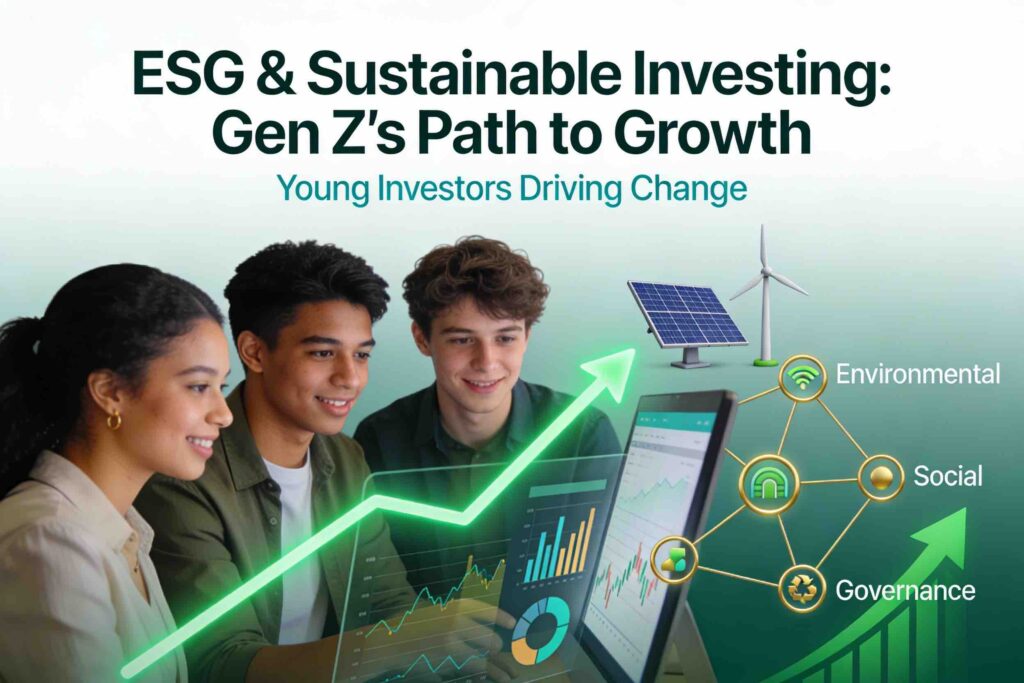
In today’s world, more investors than ever are asking themselves a fundamental question: can my money make a difference? The answer is a resounding yes. Environmental, Social, and Governance (ESG) investing has evolved from a niche movement into a mainstream investment strategy, and nowhere is this trend more pronounced than among Gen Z investors. With approximately 99% of Gen Z showing interest in sustainable investing and 80% planning to increase their allocations in sustainable options, it’s clear that values-based investing is reshaping the financial landscape.
This shift isn’t merely a feel-good trend. Research demonstrates that sustainable mutual funds and ESG-focused portfolios can deliver competitive returns while simultaneously contributing to positive environmental and social outcomes. If you’ve been curious about aligning your investment strategy with your personal values, this comprehensive guide will walk you through the essentials of ESG investing, from understanding the basics to selecting the right funds for your financial goals.
Understanding ESG Investing: More Than Just a Buzzword
At its core, ESG investing involves evaluating companies based on three interconnected criteria. The environmental pillar examines a company’s impact on nature, including carbon emissions, waste management, and resource consumption. The social component assesses employee welfare, gender equality, community engagement, and labor practices. Finally, governance evaluates corporate policies, regulatory compliance, transparency, and the effectiveness of board structures.
What makes ESG investing compelling is that it doesn’t ask investors to choose between their values and their returns. Instead, it recognizes that companies with strong ESG performance often demonstrate superior risk management, better innovation capabilities, and stronger operational efficiency. In fact, companies integrating ESG principles frequently enjoy more productive workforces, higher customer loyalty, lower litigation costs, and enhanced brand reputation—all factors that translate to long-term financial resilience.
The surge in sustainable investing is driven by compelling data. Nearly 60% of all investors now plan to increase their allocations to sustainable investments over the next year, with just 3% planning to decrease. This momentum suggests that ESG investing is no longer a peripheral strategy but a fundamental shift in how the investment industry allocates capital.
Navigating the ESG Landscape: Mutual Funds vs. ETFs
When building a sustainable portfolio, investors face a key decision: mutual funds or exchange-traded funds (ETFs)? Both offer exposure to ESG-screened companies, but they serve different investment styles.
Sustainable Mutual Funds provide actively managed ESG investing opportunities, where professional fund managers carefully select holdings based on ESG criteria. These funds must invest at least 65% of their assets in companies that provide comprehensive Business Responsibility and Sustainability Reporting (BRSR). When selecting an ESG mutual fund, look for funds that clearly disclose monthly portfolio BRSR scores, detail their ESG rating providers, and transparently share their voting decisions on ESG matters. This transparency is crucial for understanding how the fund manager translates ESG principles into actual investment decisions.
Sustainable ETFs, by contrast, track ESG-focused indices and offer passive exposure to multiple companies that meet specific environmental, social, or governance standards. The thematic ETF category has experienced explosive growth, with assets managed in U.S.-listed thematic funds expanding nearly tenfold from $9.7 billion in 2014 to $92.7 billion in 2024. This explosive growth reflects the sophistication of thematic investing strategies and their appeal to investors seeking targeted ESG exposure.
Top ESG ETFs for Building Your Sustainable Portfolio
If you’re interested in sustainable ETFs, several standout options offer excellent diversification and low costs. The iShares ESG Aware MSCI USA ETF (ESGU) is one of the largest, with $13.9 billion in net assets and a remarkably low 0.15% expense ratio. For investors seeking even lower fees, the Vanguard ESG U.S. Stock ETF (ESGV) provides broad U.S. market exposure with a 0.09% expense ratio, making it an economical choice for long-term investors.
International investors shouldn’t overlook the iShares ESG Aware MSCI EAFE ETF (ESGD), with $9.6 billion in assets and a 0.21% expense ratio, or the Vanguard ESG International Stock ETF (VSGX), with $4.8 billion in assets and a 0.10% expense ratio. These funds provide essential global diversification while maintaining strict ESG screening standards.
For those passionate about environmental solutions, the iShares Global Clean Energy ETF (ICLN) offers targeted exposure to renewable energy and clean technology companies, though its 0.41% expense ratio reflects its more specialized focus. This thematic ETF exemplifies how ESG investing can address specific environmental challenges while building wealth.
Thematic ETFs: Investing in Tomorrow’s Solutions Today
Thematic ETFs represent an increasingly popular subset of sustainable investing, allowing investors to target specific trends and solutions. These funds focus on particular themes rather than broad ESG criteria, enabling more concentrated exposure to emerging opportunities.
Clean Energy ETFs invest in companies developing renewable energy sources like wind, solar, and hydroelectric power. These funds benefit from the global energy transition, which over 80% of investors recognize as an opportunity to generate returns.
Green Technology ETFs focus on companies innovating in energy efficiency, waste reduction, and emissions control. As businesses worldwide accelerate their sustainability journeys, these companies stand to benefit significantly.
Water Management ETFs address a critical global challenge by investing in companies managing, purifying, and conserving water resources. With global water scarcity intensifying, this thematic category presents compelling long-term growth potential.
Social Responsibility ETFs emphasize companies with strong labor practices, gender diversity in leadership, and fair compensation policies. The SPDR SSGA Gender Diversity Index ETFexemplifies this approach, specifically selecting firms with exceptional gender diversity in management.
Governance-Focused ETFs prioritize transparency, board independence, and ethical corporate structures, appealing to investors who believe strong governance drives sustainable performance.
The Three Pillars of ESG: Building a Balanced Approach
Understanding the three components of ESG investing helps you make more informed decisions about fund selection. A well-rounded sustainable portfolio typically includes exposure across all three dimensions rather than focusing exclusively on one.
Environmental investing addresses climate change and ecological preservation through ESG criteria that evaluate carbon footprint, energy efficiency, and sustainable resource management. Impact investing with an environmental focus can directly reduce portfolio carbon footprint and align holdings with climate goals.
Social investing considers labor practices, community engagement, supply chain ethics, and employee wellness. Funds emphasizing the social component often appeal to investors concerned with income inequality, workplace fairness, and community development.
Governance investing focuses on corporate leadership quality, board composition, executive compensation structures, and stakeholder engagement. Strong governance often correlates with lower company-specific risk, contributing positively to portfolio diversification.
The Critical Issue: Avoiding Greenwashing
While the growth of sustainable investing is encouraging, it has also created opportunities for deception. Greenwashing—the practice of making misleading claims about environmental or social practices—represents the top barrier to ESG investing for many investors. Learning to identify and avoid greenwashing is essential for building a genuinely sustainable portfolio.
Red flags include vague language or unverifiable sustainability claims, selective or inconsistent ESG disclosures, and overemphasis on long-term goals without concrete short-term action plans. Some companies engage in impact-washing by overstating their portfolio’s positive impacts, while others practice green-hushing by remaining silent about sustainability goals and progress.
To avoid greenwashing, employ these strategies: conduct thorough reviews of companies’ sustainability reports and ESG strategies, use third-party ESG ratings and certifications from established providers like MSCI, Sustainalytics, or Refinitiv, monitor news coverage for emerging ESG controversies, and engage directly with asset managers about their ESG performance and transparency standards. Many financial advisors now use specialized tools that analyze funds along five critical dimensions, including alignment with global climate goals, exposure to climate transition risks, and connections to controversial business activities.
How ESG Investing Impacts Portfolio Performance and Risk Management
One of the most persistent myths about sustainable investing is that it requires sacrificing returns. Research consistently challenges this assumption. Studies examining socially responsible investing (SRI) and ESG-integrated portfolios find that these strategies don’t hurt returns and may actually reduce risk.
Funds with higher social active share—a measure of how differently a fund weights ESG-conscious stocks compared to its benchmark—tend to outperform their counterparts with lower social active share. More importantly, socially responsible funds typically exhibit lower risk than conventional funds, providing investors the best of both worlds: competitive returns with reduced volatility.
During periods of market stress, such as the COVID-19 pandemic, ESG-integrated portfolios demonstrated superior resilience compared to traditional portfolios. Companies with strong ESG performance were better equipped to withstand value destruction than their peers with weaker ESG performance, suggesting that ESG factors provide valuable protection during market turbulence.
The relationship between ESG integration and portfolio diversification is nuanced but ultimately positive. While including ESG screens might reduce the number of available investments or correlate holdings differently, the average specific risk of stocks with high ESG ratings is substantially lower than identical stocks with weaker ESG ratings. This risk reduction through lower portfolio volatility represents a genuine diversification benefit that strengthens long-term wealth building.
Selecting the Right ESG Mutual Fund for Your Goals
Choosing an ESG mutual fund requires a systematic approach balancing financial objectives with sustainability impact. Begin by assessing the fund’s cost-benefit ratio, considering expected risk-adjusted returns, ESG impact measurement, portfolio management costs, and your long-term sustainability goals.
Next, evaluate how the fund fits within your overall portfolio. Use a multi-index model considering both traditional financial metrics and ESG factors. This approach helps you assess risk-adjusted performance while understanding the fund’s true ESG characteristics beyond marketing claims.
Critical assessment criteria include:
Fee Structure: Lower expense ratios mean more of your returns work for you. Compare fees carefully, as they compound significantly over decades.
ESG Methodology: Understand whether the fund uses negative screening (excluding poor ESG performers), positive screening (selecting ESG leaders), or ESG integration (incorporating ESG factors into traditional analysis). Each approach delivers different risk and return profiles.
Transparency: Demand clear disclosure of holdings, ESG scores, and the fund manager’s voting record on ESG matters. A fund that can’t or won’t explain its ESG approach warrants skepticism.
Performance Track Record: Review both ESG impact metrics and financial returns over multiple market cycles. Strong ESG funds demonstrate resilience during market stress.
Diversification: Ensure the fund provides adequate diversification across sectors and geographies rather than concentrating excessively in trendy ESG themes.
Regularly review your sustainable portfolio’s ESG ratings and adjust holdings as needed, ensuring investments continue to meet both your financial goals and sustainability standards while maintaining optimal tax efficiency.
Impact Investing: Creating Measurable Change
For investors seeking deeper engagement with sustainability, impact investing offers a more intentional approach. Impact investing is marked by an explicit desire to contribute to measurable social and environmental benefits alongside financial returns. Rather than simply excluding harmful companies or selecting leaders in ESG performance, impact investing targets specific outcomes—like renewable energy capacity deployed, carbon emissions reduced, or communities benefiting from economic opportunity.
This approach requires more active engagement and often involves longer investment horizons, but it appeals to investors who want their capital to directly fund solutions to global challenges. A Gen Z investor passionate about climate change, for example, might use impact investing to specifically support companies developing breakthrough climate technologies while simultaneously building wealth.
Building Your Values-Aligned Portfolio
Creating a sustainable portfolio that genuinely reflects your values requires thoughtful planning. Start by clarifying your values. Do you prioritize environmental sustainability, social justice, governance integrity, or some combination? Your priorities should guide your fund selection.
Next, determine your asset allocation. ESG investing works within traditional portfolio frameworks. You might maintain a core allocation to broad ESG equity funds supplemented by thematic ETFs for specific environmental or social themes. Consider your risk tolerance, time horizon, and financial goals—ESG investing doesn’t eliminate the need for sound financial planning principles.
Finally, commit to regular monitoring and rebalancing. Set reminders to review your sustainable portfolio at least annually, assessing both financial performance and ESG impact alignment. As companies evolve and new funds emerge, your portfolio may benefit from adjustments to better align with your values and financial objectives.
The Future of Sustainable Investing
The trajectory is clear: sustainable investing will continue growing in importance. With climate change accelerating, social inequality persisting, and corporate accountability demanding attention, investors increasingly recognize that their capital represents power to influence global outcomes.
For Gen Z and younger investors, this represents an unprecedented opportunity. Unlike previous generations, younger investors are building wealth during an era when sustainable investing is mainstream, low-cost, and performance-competitive. By selecting the right ESG mutual funds and sustainable ETFs, investing in thematic opportunities, and avoiding greenwashing traps, you can build a portfolio that generates wealth while advancing the causes you believe in.
Conclusion
Aligning your portfolio with your values isn’t a sacrifice—it’s an investment strategy that recognizes the inseparability of financial performance and sustainable business practices. With 99% of Gen Z interested in sustainable investing and proven evidence that ESG-integrated portfolios deliver competitive risk-adjusted returns, the question is no longer whether to invest sustainably, but how to do so effectively.
Start by understanding the three pillars of ESG investing: environmental impact, social responsibility, and governance quality. Explore both sustainable mutual funds and ETFs, compare expense ratios and holdings, and avoid greenwashing by demanding transparency and third-party validation. Consider whether impact investing aligns with your desire for measurable change. Most importantly, remember that ESG investing is a long-term strategy—the power of compound returns combined with growing corporate accountability will reward patient, thoughtful investors who align their portfolios with their values today.
- Sunita Williams’ Secret: Astronaut Mindset That Builds Crores via SIP Investing
 Discover Sunita Williams’ astronaut mindset for wealth building: Solve crises “one bite at a time” like mutual fund SIP investing. Learn disciplined saving, risk pivots, and best mutual funds India strategies from her 27-year NASA career.
 - The ₹1 Magic: Transform Pocket Change Into ₹1,378 With This Simple 52-Week Plan
 Transform your finances with India’s most popular 52-week money challenge. Save just ₹1 in week one, building to ₹52 by year-end for a total of ₹1,378. Discover the reverse challenge, practical tips, and how consistent saving habits create lasting financial freedom.
 - Forget 10% Salaries: Why 48% of India’s Gen Z are Starting SIPs with Just ₹500
 Discover how India’s Gen Z is building wealth with just ₹500 monthly SIPs. From ₹3 trillion in SIP inflows to 100 million active accounts, young investors are leveraging compound interest and disciplined investing to achieve financial independence without hefty salaries or trust funds.
 - Is Your Credit Card Quietly Killing Your Score? The 30% Factor Lenders Watch Closely
 Credit utilization ratio can quietly make or break your CIBIL score. Keeping card usage below 30% signals control, not desperation. With simple moves—mid‑cycle payments, spreading spends, and requesting higher limits—you can boost approval odds and pay less interest overall today.
 - Need a Loan? Use These 7 No-Gimmick Tactics to Fix Your CIBIL Score in Just 30 Days
 Boost your CIBIL score by 50+ points in just 30 days with proven tactics. Master payment history, reduce credit utilization, and dispute errors to unlock better loan approvals and lower interest rates. No gimmicks—just real strategies that work.
 - You’re Sitting on a Goldmine: How Your UPI History Can Help You Build Wealth
 Your UPI transaction history holds the key to financial freedom. Discover how to leverage daily payment data for expense tracking, budget optimization, and wealth creation. Transform invisible spending into actionable insights and take control of your financial future today.
 - Paying Multiple EMIs? This One Move Could Save You Up to ₹4 Lakhs in Interest
 Drowning in multiple EMIs? Discover how debt consolidation strategy can transform your finances by merging several loans into one smart EMI plan. Learn proven techniques to reduce interest costs, simplify payments, and regain financial control as an Indian urban professional.
 - This One Switch Could Save You ₹57 Lakhs by 2026: Robo-Advisors vs. Human Experts
 Robo-advisors like Groww, Upstox, and Kuvera offer algorithm-driven, transparent, low-cost investing for millennials and Gen Z. Compare features, fees, and benefits against traditional human advisors. Discover which approach—or hybrid model—suits your financial goals best in 2025.
 - Is Your Portfolio Missing Out? The ‘Green’ Strategy That’s Quietly Outperforming the Market
 Discover how to align your investment portfolio with your values through ESG and sustainable investing. Learn about sustainable mutual funds, thematic ETFs, and impact investing strategies perfect for Gen Z investors seeking competitive returns while supporting environmental and social change.
 - Beyond the Paycheck: How India’s New Workforce is Turning Side Gigs Into Wealth Engines
 Over 60% of Gen Z in India freelance for financial independence. Master income tracking, GST registration, tax deductions, and retirement planning without employer benefits. Learn Section 44ADA presumptive taxation, advance tax strategies, and insurance essentials for gig economy success.
Pingback: New Tax Regime: ₹12.75 Lakh Tax-Free Income 2026