
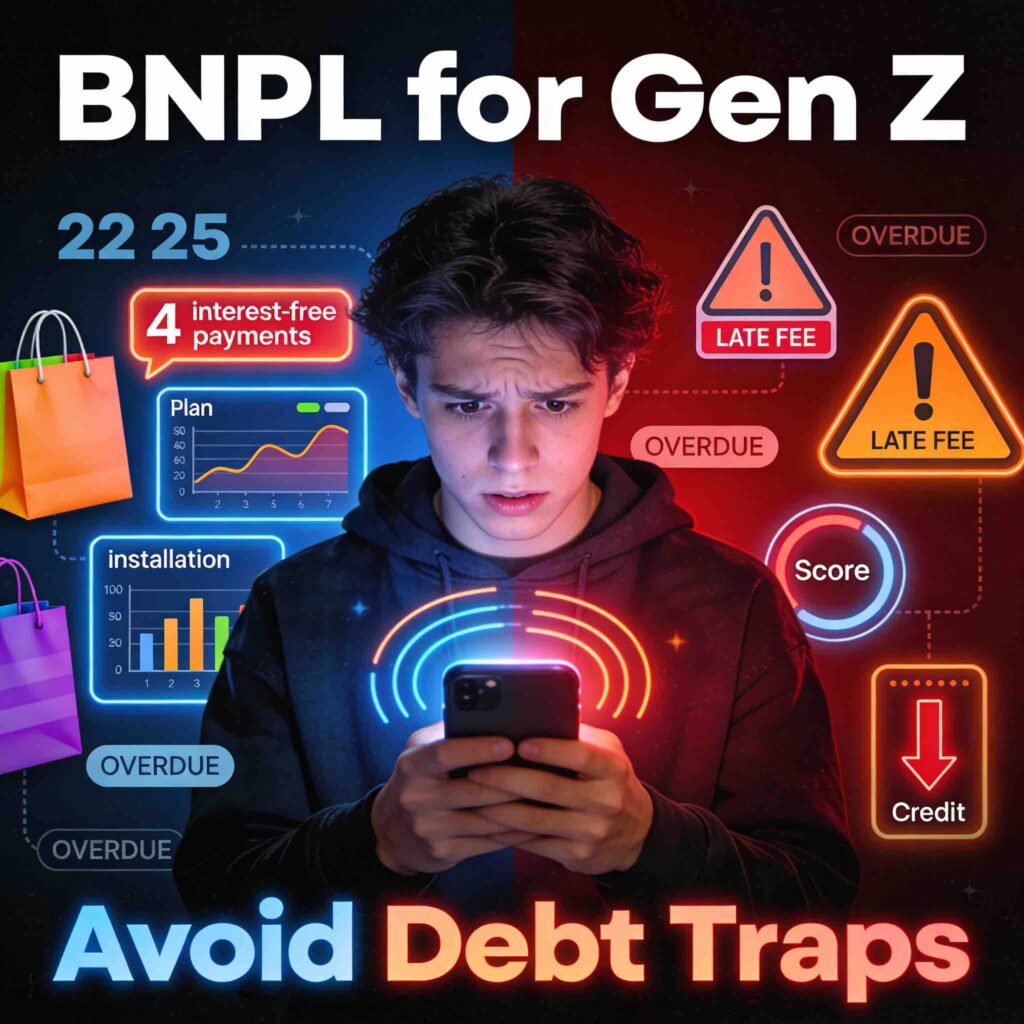
The checkout screen glows before you. That outfit you’ve been eyeing for weeks sits in your cart. You’re about to hit the back button when something catches your eye: “Pay Later.” Suddenly, those ₹5,000 feel manageable. You can have it today and worry about three installments later. Welcome to the world of Buy Now, Pay Later—a payment revolution that’s fundamentally changing how Gen Z shops in India.
India’s BNPL market is exploding. With approximately 70% of Gen Z using Buy Now, Pay Later services for purchases under ₹7,000, this isn’t a passing trend anymore. It’s become the default payment method for millions of young Indians who’d rather split costs than pay upfront. But here’s what matters: knowing how to leverage BNPL strategically can make you financially smarter. Misusing it can trap you in a debt cycle that’s harder to escape than you’d think.
Understanding BNPL: How It Works and Why It’s Different from Credit Cards
Before diving into strategy, let’s clarify what Buy Now, Pay Later actually is. These digital payment services allow you to purchase something today and spread the cost across multiple installments—typically interest-free for a set period. Unlike traditional credit cards that require extensive documentation and weeks of waiting for approval, BNPL services approve you in minutes using just your phone.
Here’s the mechanics: You’re browsing Amazon or Flipkart. You find something you want. At checkout, instead of using your debit card, you select a BNPL provider. You make your first payment immediately, and the remaining balance gets divided into equal installments—usually over 2 to 12 weeks, depending on the provider.
The psychological difference between BNPL and credit cards runs deeper than the numbers. With a credit card, you see the entire charge at the end of the month, creating what psychologists call “the pain of paying.” With BNPL, those small installments feel manageable. ₹5,000 becomes ₹625 per week. It doesn’t feel like debt. It feels like a small, affordable decision—except when you’ve made that decision 10 times across different apps.
This is the critical distinction that separates responsible BNPL users from those who fall into debt traps. Credit cards slap you with an annual percentage rate (APR) between 20-50%, but they’re transparent about it. Many BNPL services feel free because they areinterest-free—until they suddenly aren’t. The interest kicks in only if you extend your payment beyond the promotional period, creating a false sense of financial freedom.
The Top BNPL Platforms in India: A Smart Comparison
The BNPL landscape in India includes several major players, each with distinct strengths and weaknesses. Understanding these differences helps you choose platforms that align with your spending habits.
LazyPay has emerged as the dominant force in India’s Buy Now, Pay Later market. Backed by PayU, it operates across 45,000+ online merchants including Flipkart, Amazon, and Swiggy. Its headline feature is a credit limit reaching ₹1,00,000, though most Gen Z users operate well below this. LazyPay offers a 15-day interest-free period for standard purchases and no-cost EMI options ranging from 3 to 12 months for larger buys. The downside? User reviews highlight aggressive collection practices and sudden late fees that catch people off guard.
Amazon Pay Later integrates seamlessly into your Amazon shopping experience. If you’re already in the Amazon ecosystem, this feels frictionless—one less app to manage. Credit limits vary based on KYC verification, with a regulatory cap of ₹60,000 yearly for basic verification users. The processing fee of 1.18% (including GST) appears when you convert to EMIs. The problem: limited usability outside Amazon restricts its utility if you shop across multiple platforms.
Cashfree positions itself as the bridge between traditional and digital commerce. While not as widely known as LazyPay, it partners with numerous merchants and offers flexible payment terms. For Gen Z specifically, Cashfree’s strength lies in its straightforward fee structure with no hidden charges on shorter repayment periods.
For a practical comparison: if you’re making purchases primarily on Amazon and don’t mind ecosystem lock-in, Amazon Pay Later wins. If you shop everywhere—from fashion websites to food delivery apps—LazyPay’s broader merchant network makes sense. The ideal approach? Use one primary BNPL app to consolidate your payments into a single due date, reducing the cognitive load of juggling multiple deadlines.
The Hidden Psychology of BNPL and Impulse Spending
Here’s something the BNPL apps don’t advertise: they’re psychologically engineered to make you spend more. When neuroscientists study purchasing behavior, they’ve identified something called the “pain of paying”—the discomfort your brain experiences when money leaves your account. Traditional shopping intensifies this pain. You hand over cash. You see the debit. The loss feels real.
BNPL applications eliminate this pain almost entirely. That ₹2,000 hoodie isn’t ₹2,000 anymore. It’s ₹500 next week, ₹500 the week after. Your brain doesn’t process this as spending ₹2,000. It processes this as a ₹500 decision repeated four times. Psychologically, ₹500 feels manageable. ₹2,000 doesn’t.
This cognitive trick is so powerful that studies show BNPL users spend 40-50% more than they would with traditional payment methods. The mechanism isn’t complicated: lower perceived cost per transaction equals more transactions. Over time, these “small” purchases accumulate into hundreds of thousands of rupees in outstanding payments.
This is where the “debt trap” concept comes in. It’s not about one catastrophic decision. It’s about a thousand small ones that felt reasonable individually but catastrophic in aggregate.
Smart Gen Z users counter this by treating BNPL like real credit. Before using a BNPL service, ask yourself: Would I buy this with a credit card right now? Would I feel comfortable seeing the full ₹5,000 charge on my statement? If the answer is no, BNPL isn’t making it a better decision—it’s just making a bad decision feel less bad.
The Debt Trap: Why Good Intentions Go Wrong
Statistically, the Gen Z users most likely to fall into BNPL debt traps aren’t reckless spenders. They’re actually careful people who made a series of individually responsible decisions that collectively spiraled.
Here’s the typical scenario: You use LazyPay for a ₹3,000 purchase due on the 15th. Three days later, you use Amazon Pay Later for a ₹2,000 gadget due on the 18th. The next week, you use a third BNPL app for ₹1,500 in clothes due on the 22nd. Each decision felt fine. Each purchase solved a real need or want.
But now you have three payment due dates across three different apps. If you miss even one—whether due to an unexpected expense or simple forgetfulness—you’re facing late fees ranging from ₹100 to ₹500 depending on the provider. Miss a few payments and suddenly that 0% interest rate becomes 24-36% annual interest. Your ₹5,000 in purchases just cost you ₹6,200.
The second trap is more insidious: credit score damage. While many BNPL providers don’t report to credit bureaus directly, missed payments that get sent to collection agencies absolutely do. A single collection notice can drop your credit score by 50-100 points. This matters because when you want a real loan later—for education, a car, or a home—banks will see that history.
The third trap is the cascade effect. As your BNPL debts grow, your available credit with each provider shrinks (most have monthly credit refresh cycles). This pushes some users toward taking personal loans to cover BNPL payments—creating a debt cycle that’s genuinely difficult to escape.
Strategic BNPL Use: The Smart Saver’s Framework
So how do you use Buy Now, Pay Later without falling into these traps? The answer is discipline, not avoidance. BNPL, when used strategically, is genuinely useful for Gen Z readers.
Rule One: The Budget-First Principle
Before you even download a BNPL app, know exactly how much you can spend monthly without affecting your emergency fund or savings. Many financial advisors suggest the 50/30/20 rule: allocate 50% of your income to necessities, 30% to wants, and 20% to savings and debt repayment. Your BNPL spending should come entirely from the “wants” portion, not from borrowed future money.
Create a simple spreadsheet tracking all active BNPL payments. Include the amount, the due date, and which app it’s on. This single document—updated weekly—prevents the “forgot I had another payment due” scenario that trips up most Gen Z users.
Rule Two: One App, One Due Date
This is non-negotiable if you want to avoid the juggling trap. Choose one BNPL platform and use it exclusively. Yes, LazyPay might not work at every store. Yes, you’ll occasionally have a purchase that’s not available. But that one-off inconvenience is worth the protection against managing multiple due dates, multiple fee structures, and multiple late-payment penalties.
If you absolutely must use two platforms (perhaps Amazon Pay Later for Amazon purchases), set them on the same due date. Most BNPL apps let you customize payment scheduling—use this feature religiously.
Rule Three: Interest-Free Period Calculation
Understanding when your interest-free period ends is crucial. If LazyPay gives you 15 days interest-free, mark day 14 on your calendar. Set a phone reminder. Your goal should be complete payment before that deadline. Some users are tempted to extend into EMI mode to “manage cash flow better,” but this is where the 24%+ interest rates catch you.
Quick math: A ₹10,000 purchase extended to a 12-month EMI at 24% interest costs you ₹11,320 total. That ₹1,320 is real money lost to interest. If you can’t pay the full amount before the interest-free period ends, you couldn’t afford the purchase in the first place.
Rule Four: The “Would I Use a Credit Card?” Test
This is your final filter. Before checking out with any BNPL app, ask yourself: If this product wasn’t available on BNPL, would I buy it with my debit card immediately? Would I charge it to a credit card knowing I’d see the full amount due next month?
If the answer is no, step away from checkout. BNPL isn’t making this a smart purchase—it’s making an impulse look smart. The fact that you can afford the ₹500 weekly installments is irrelevant if you can’t afford the ₹2,000 today.
Avoiding the Debt Cascade: Practical Guardrails
Beyond the strategic rules above, here are tactical steps that prevent the spiral into unmanageable debt:
Track Everything Religiously
Use apps like Walnut or even a simple Google Sheet. Every rupee you owe on BNPL should be visible at a glance. This visibility is your primary defense against accumulating debt silently.
Set Automatic Payments (Cautiously)
This prevents missed payments, but only if you verify funds are available 2-3 days before. Nothing’s worse than an automatic payment bouncing, triggering overdraft fees and late penalties.
Avoid Stacking Multiple BNPL Services
The temptation is real: “I already have one BNPL payment due on the 10th, so I can definitely handle another on the 15th and another on the 20th.” Wrong. Each additional BNPL payment increases cognitive load and failure risk exponentially.
Build a BNPL-Free Month Quarterly
Every three months, challenge yourself to not use any BNPL services for an entire month. This serves two purposes: it breaks the psychological cycle where BNPL becomes automatic, and it forces you to evaluate whether you’ve actually been spending more than you would without it.
Know Your Red Flags
If you’re using BNPL to pay for necessities (groceries, utilities, medicine), stop immediately. BNPL is meant for discretionary purchases only. If you’re taking personal loans to cover BNPL payments, you’re in crisis mode and need external help.
The Psychological Difference That Matters
Let’s return to the core psychological distinction that separates responsible BNPL users from those trapped in debt. Credit cards are honest about their cost. You see interest rates clearly: 24%, 36%, whatever. The pain is transparent.
BNPL’s psychological advantage is also its danger. By hiding the full cost and spreading payments, it triggers what behavioral economists call “hyperbolic discounting”—the tendency to undervalue future costs compared to present benefits. That ₹5,000 hoodie today feels more valuable than the financial stress of three ₹1,667 payments over three months.
Smart Gen Z savers reverse this psychological bias intentionally. They treat BNPL exactly like a credit card with 24% interest. They imagine the total cost paid immediately. They ask not “Can I afford the installments?” but “Would I pay ₹5,000 cash today for this?” This simple reframing prevents the majority of BNPL debt traps.
Real Gen Z Stories: Where BNPL Works and Where It Breaks
Consider Priya, a 24-year-old marketing professional earning ₹4,00,000 annually. She uses LazyPay exclusively for fashion purchases under ₹3,000, always within her monthly discretionary budget. She pays off each purchase before the interest-free period ends. Result: BNPL provides genuine convenience with zero debt risk.
Now compare this to Rohan, also 24, also earning similarly. He uses three BNPL apps across different merchants, carrying ₹25,000 in active purchases across platforms. He extended two purchases into EMI mode and missed one payment, which was reported to a collections agency. His credit score dropped from 750 to 680, and he’s now paying the price through higher interest rates on a car loan he’s applying for.
The difference isn’t intelligence or income. It’s strategy and discipline. Priya used BNPL as a tool for convenience. Rohan used it as a tool for debt that he pretended wasn’t debt.
Your Action Plan Starting Today
If you’re reading this and realizing you’re moving toward Rohan’s situation, the recovery path is concrete:
- List all active BNPL payments with due dates and amounts. Get this visible today.
- Choose one primary BNPL app. Uninstall the others if the temptation is too strong.
- Consolidate your payment due dates. Most BNPL providers allow flexibility here—use it.
- Set phone reminders for 3 days before each payment due date.
- Stop using BNPL immediately until all current payments are cleared.
- If you’re in EMI mode, focus on clearing these before any new BNPL purchases.
The Gen Z advantage in the financial world is technology comfort and digital literacy. Use this advantage to manage BNPL smartly, and it becomes a genuine convenience. Use it carelessly, and it becomes a trap that’s easier to fall into than to escape.
Final Thought: Patience as a Financial Superpower
In a world optimized for instant gratification, there’s something radical about waiting. Waiting to buy until you have the cash. Waiting until you’ve verified you actually want something before purchase. Waiting to upgrade your phone until your current one breaks.
This patience isn’t deprivation. It’s the foundation of financial security. BNPL’s genius is making patience feel unnecessary. The real skill—the one Gen Z can develop right now—is recognizing when patience is actually serving you better than any app ever could.
Use Buy Now, Pay Later as a tool for genuine convenience, not as a substitute for financial discipline. Track ruthlessly, pay immediately, and remember that the cheapest purchase is always the one you don’t make.
Your future financial self will thank you.
- Sunita Williams’ Secret: Astronaut Mindset That Builds Crores via SIP Investing
 Discover Sunita Williams’ astronaut mindset for wealth building: Solve crises “one bite at a time” like mutual fund SIP investing. Learn disciplined saving, risk pivots, and best mutual funds India strategies from her 27-year NASA career.
 - The ₹1 Magic: Transform Pocket Change Into ₹1,378 With This Simple 52-Week Plan
 Transform your finances with India’s most popular 52-week money challenge. Save just ₹1 in week one, building to ₹52 by year-end for a total of ₹1,378. Discover the reverse challenge, practical tips, and how consistent saving habits create lasting financial freedom.
 - Forget 10% Salaries: Why 48% of India’s Gen Z are Starting SIPs with Just ₹500
 Discover how India’s Gen Z is building wealth with just ₹500 monthly SIPs. From ₹3 trillion in SIP inflows to 100 million active accounts, young investors are leveraging compound interest and disciplined investing to achieve financial independence without hefty salaries or trust funds.
 - Is Your Credit Card Quietly Killing Your Score? The 30% Factor Lenders Watch Closely
 Credit utilization ratio can quietly make or break your CIBIL score. Keeping card usage below 30% signals control, not desperation. With simple moves—mid‑cycle payments, spreading spends, and requesting higher limits—you can boost approval odds and pay less interest overall today.
 - Need a Loan? Use These 7 No-Gimmick Tactics to Fix Your CIBIL Score in Just 30 Days
 Boost your CIBIL score by 50+ points in just 30 days with proven tactics. Master payment history, reduce credit utilization, and dispute errors to unlock better loan approvals and lower interest rates. No gimmicks—just real strategies that work.
 - You’re Sitting on a Goldmine: How Your UPI History Can Help You Build Wealth
 Your UPI transaction history holds the key to financial freedom. Discover how to leverage daily payment data for expense tracking, budget optimization, and wealth creation. Transform invisible spending into actionable insights and take control of your financial future today.
 - Paying Multiple EMIs? This One Move Could Save You Up to ₹4 Lakhs in Interest
 Drowning in multiple EMIs? Discover how debt consolidation strategy can transform your finances by merging several loans into one smart EMI plan. Learn proven techniques to reduce interest costs, simplify payments, and regain financial control as an Indian urban professional.
 - This One Switch Could Save You ₹57 Lakhs by 2026: Robo-Advisors vs. Human Experts
 Robo-advisors like Groww, Upstox, and Kuvera offer algorithm-driven, transparent, low-cost investing for millennials and Gen Z. Compare features, fees, and benefits against traditional human advisors. Discover which approach—or hybrid model—suits your financial goals best in 2025.
 - Is Your Portfolio Missing Out? The ‘Green’ Strategy That’s Quietly Outperforming the Market
 Discover how to align your investment portfolio with your values through ESG and sustainable investing. Learn about sustainable mutual funds, thematic ETFs, and impact investing strategies perfect for Gen Z investors seeking competitive returns while supporting environmental and social change.
 - Beyond the Paycheck: How India’s New Workforce is Turning Side Gigs Into Wealth Engines
 Over 60% of Gen Z in India freelance for financial independence. Master income tracking, GST registration, tax deductions, and retirement planning without employer benefits. Learn Section 44ADA presumptive taxation, advance tax strategies, and insurance essentials for gig economy success.
Pingback: Embedded Finance 2026: UPI to Digital Assets Explained