
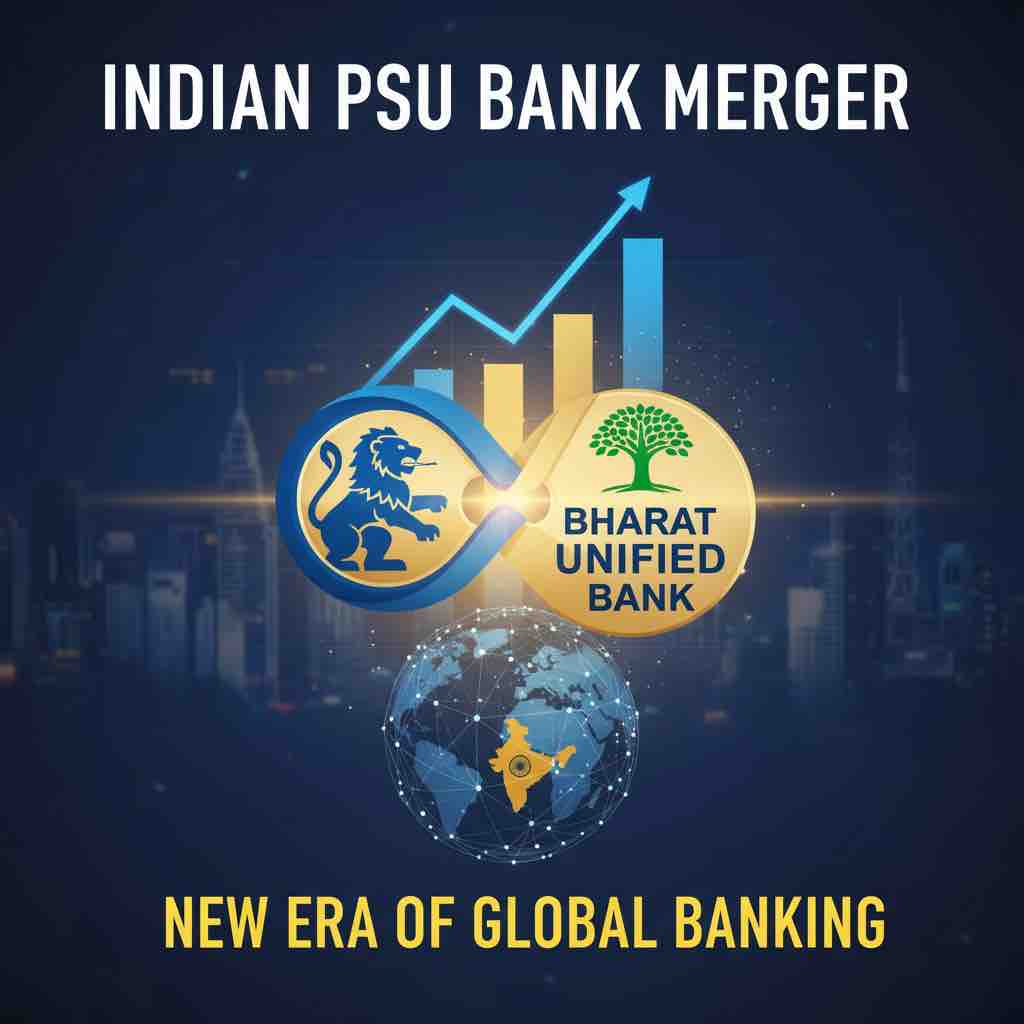
India’s public sector banks (PSBs) stand at a crossroads. Despite India’s banking system serving over 1.4 billion people, only two Indian banks rank within the global top 100 by assets—and none in the coveted top 20. Under PSB Manthan 2.0 and the Developed India 2047vision, the Finance Ministry proposes a second phase of mega-mergers to create at least two PSBs with assets rivaling the world’s largest. This blog explores past consolidation, the rationale for renewed mergers, the phased roadmap to 2047, quantitative targets, benefits, risks, and stakeholder roles in this landmark initiative.
1. The State of India’s PSBs Today
As of March 2025, India has 12 PSBs following the 2017–19 consolidation drive.
- State Bank of India (SBI) remains the country’s largest bank with total assets of ₹7,314,185 crore (approximately US $868 billion). Globally, SBI ranks around 43rd by assets.
- HDFC Bank, India’s largest private lender, holds assets of ₹4,392,417 crore (about US $522 billion), placing it within the global top 100 by assets but well below the top 20 threshold.
By contrast, the world’s largest banks dwarf these figures:
- Industrial and Commercial Bank of China (ICBC) leads with assets exceeding ¥52 trillion (around US $6.3 trillion) ,
- UBS’s balance sheet stands at ₹148 trillion (roughly US $1.8 trillion).
None of India’s PSBs apart from SBI make the top 50, underscoring the imperative for scale-enhancing mergers.
2. Lessons from Phase 1: 2017–19 Consolidation
Phase 1 of PSB consolidation occurred in two waves:
- 2017: SBI merged its five associate banks and Bharatiya Mahila Bank, forming a single, larger SBI.
- 2019: Ten PSBs consolidated into four entities—Punjab National Bank, Canara Bank, Union Bank of India, and Indian Bank—reducing total PSBs from 27 to 12.
This drive improved capital adequacy, reduced overlapping operations, and streamlined governance. Yet, even post-merger, India’s largest PSB remained only mid-ranked globally by assets, motivating a second consolidation round.
3. Why Phase 2? The Case for Mega-Mergers
3.1 Financing India’s Infrastructure Ambition
India must mobilize approximately US $4.5 trillion in infrastructure investment by 2040 to support urbanization, manufacturing corridors, renewable energy, and social development. Individual PSBs lack the balance-sheet heft to underwrite multi-billion-dollar projects alone; mega-banks can directly fund highways, ports, and power plants without extensive syndication.
3.2 Reviving Credit Growth
Credit growth in FY 2024 fell below 10%, constraining industry and MSME expansion. Larger PSBs would wield competitive advantage over private lenders in capturing large corporate mandates and reducing reliance on multiple smaller lenders.
3.3 Global Competitiveness
Aggressive organic growth can raise SBI’s assets from US $868 billion to match the 20th largest bank (UBS at US $1.8 trillion), but requires annual Compounded Annual Growth Rate (CAGR) of 5–8%—challenging given global peers’ simultaneous growth. For HDFC and other mid-sized banks, double-digit CAGR would be necessary. Mergers offer an accelerated path to scale.
4. Roadmap to 2047: Three Phases
Phase 1: Foundation (2025–30)
- Champion Selection: Identify two PSBs best suited for deep consolidation (e.g., SBI plus another large PSB).
- Capital Infusion: Government to inject strategic capital to shore up tier-1 ratios.
- Governance Reforms: Grant autonomy, streamline boards, and implement global‐standard risk governance.
- Technology Upgrades: Invest in digital platforms, AI-driven analytics, and cybersecurity.
Phase 2: Globalization (2031–39)
- International Expansion: Establish branches and representative offices in key markets (Middle East, ASEAN, Africa).
- Trade Finance and Treasury Services: Build global trade corridors, cross-sell into diaspora remittances, and syndicated lending.
- Diversify Income Streams: Develop fee-based wealth management, insurance, and treasury operations.
Phase 3: Global Player (2040–47)
- Metric Alignment: Achieve capital‐adequacy, efficiency ratios, and return on equity on par with top 20 global banks.
- Sustain Top 20 Ranking: Sustain assets above the threshold (projected US $2 trillion+ for #20 by assets).
- Thought Leadership: Contribute to global financial discourse, participate in regulatory bodies (e.g., Basel Committee).
5. Quantitative Targets
- Asset Threshold: Consolidated PSB assets should exceed US $2 trillion to breach the top 20, versus US $6.3 trillion held by ICBC.
- Organic Growth Rates: Post-merger entities must pursue 5–8% CAGR in assets and 7–10% in risk-weighted assets to keep pace with global peers.
- Capital Adequacy: Maintain Common Equity Tier 1 ratio ≥14% to satisfy both domestic (RBI Basel III) and global requirements (e.g., ECB jurisdiction).
6. Benefits of Mega-Banks
6.1 Economies of Scale
- Cost Efficiencies: Merge back-office, IT, and branch networks to lower cost‐to‐income ratios.
- Pricing Power: Larger deposit base enables competitive lending rates and improved CASA ratios, boosting profitability.
6.2 Enhanced Lending Capacity
- Mega-Project Financing: Single institutions can fund ₹50 billion+ infrastructure projects, reducing syndication delays.
- Global Syndications: Co-lead international loan syndicates, attract foreign investors, and raise foreign currency debt autonomously.
6.3 Strengthened Credibility
- Credit Ratings: Higher asset base improves creditworthiness, lowering borrowing costs in bond markets.
- Investor Trust: Larger banks attract institutional investors and index funds.
7. Risks and Challenges
7.1 Credit Risk
Rapid expansion in corporate and priority sectors (agriculture, MSMEs) may elevate non-performing assets, especially if lending disciplines slacken or government loan-waiver politics intervene.
7.2 Mandate Conflict
PSBs balance social objectives (financial inclusion, priority sector lending) with commercial imperatives. Mega-banks must preserve mandates amid profit pressures.
7.3 Governance
Political interference can compromise credit decisions and impede autonomy. Effective board structures and minority representation are critical.
7.4 Regulatory Compliance
International operations require adherence to global standards—Basel III, AML/KYC norms, and data-privacy laws—necessitating robust compliance frameworks.
8. Stakeholder Roles
- Finance Ministry:
- Frame policy and legislation for PSB mergers.
- Define milestones and capital infusion strategies.
- Monitor performance against Developed India 2047 metrics.
- Reserve Bank of India (RBI):
- Enforce capital-adequacy and liquidity regulations across consolidated entities.
- Supervise cross-border operations, implement global regulatory standards.
- PSBs:
- Draft five-year transformation roadmaps covering capital raising, digital modernization, and international corridors.
- Execute merger integration meticulously—culture alignment, system harmonization.
- External Advisors:
- Leverage global investment banks, management consultants, and technology firms to design integration blueprints.
9. Conclusion
India’s ambition to field two PSBs among the world’s top 20 by assets is numerically achievablebut demands decisive merger action, sustained governance reforms, and strategic capital. The Foundation, Globalization, and Global Player phases lay a comprehensive roadmap to 2047. Balancing scale with prudence, PSBs can transform from domestic stalwarts to global heavyweights, financing India’s growth story and securing a leadership role in international banking.
- The 2026 Nationwide 3 Days Bank Strike: Why India’s Banking Backbone is Breaking
 Discover the root causes of the 2026 nationwide bank strike. Explore the struggle for 5-day banking, fair incentives, and why a Uniform Banking Standard is urgently needed to protect the dignity and job security of all bank employees.
 - UPI MDR 2026: Is UPI Still Free? Here’s the Real Answer
 A simple guide to the new UPI MDR rules effective October 15, 2026 — who pays the 0.4% merchant charge, who doesn’t, and why UPI stays free for customers.
 - Sole Proprietorship in India: Do You Need Registration? Documents & Benefits Explained
 Learn how to start a sole proprietorship firm in India, understand registration requirements, benefits, GST and Udyam registration, and discover the essential documents needed to open a business bank account. A simple beginner’s guide to launching your business confidently and correctly.
 - What is HUF? The Ancient Rule Letting Modern Families Unlock Double Tax Benefits
 Want to legally save on income tax? Discover how a Hindu Undivided Family (HUF) protects wealth and maximizes tax benefits. Explore our complete guide on HUF eligibility, the 2005 amendment, and step-by-step instructions to open an HUF bank account.
 - Exposed by RTI: Banks Recover 74% from Small Borrowers, Just 14% from Giants
 Shocking RTI data reveals a massive banking divide: banks recover 74% of bad loans from small borrowers but only 14.5% from corporate giants. Discover why ordinary citizens face harsh recovery agents while large defaulters enjoy massive loan write-offs.
Can you be more specific about the content of your article? After reading it, I still have some doubts. Hope you can help me.
I don’t think the title of your article matches the content lol. Just kidding, mainly because I had some doubts after reading the article.
Thanks for sharing. I read many of your blog posts, cool, your blog is very good.