
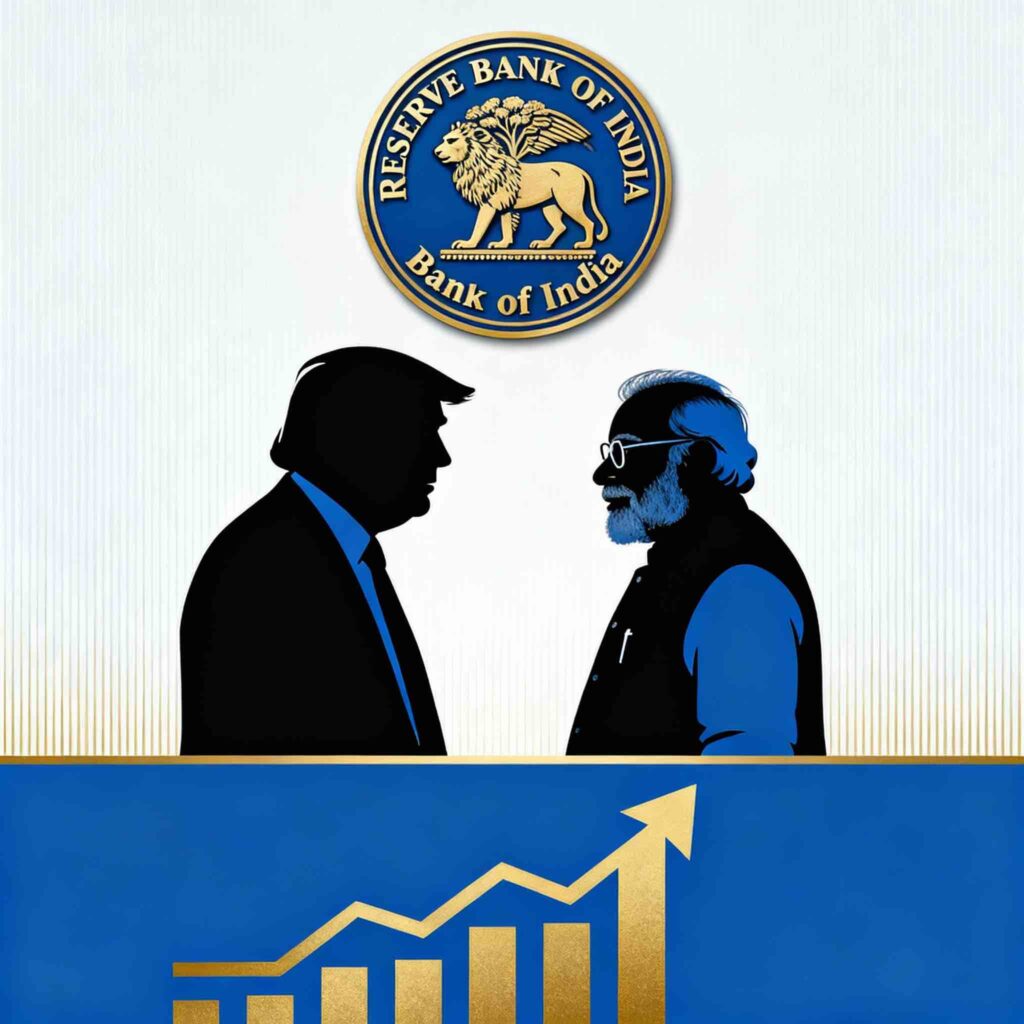
The recent commentary from the Reserve Bank of India’s Monetary Policy Committee (MPC) highlights a pivotal question: will external factors like U.S. tariffs and geopolitical developments drive India’s key policy rate lower? In an atmosphere of subdued inflation and cautious growth forecasts, the RBI has signaled its readiness to ease the repo rate, but with clear caveats. This blog unpacks the economic dynamics at play, breaks down expert opinions, and guides you through how India’s central bank navigates complex global circumstances—without losing sight of its core mandate to maintain price stability and support growth.
1. Setting the Stage: RBI’s Dual Mandate
India’s central bank operates under a dual mandate:
- Price stability, aiming to keep inflation within its target band (4% ±2%).
- Growth support, ensuring monetary conditions foster healthy economic expansion.
Since adopting the flexible inflation targeting framework in 2016, the RBI has used the repo rate—the rate at which it lends to commercial banks—as its primary policy tool. Changes in the repo rate ripple through the economy, affecting borrowing costs for businesses and consumers.
2. Current Policy Stance and the “Door Ajar” Signal
At its October meeting, the MPC opted to keep the repo rate at 5.50%, reiterating that price pressures remain manageable but growth risks linger. Governor Sanjay Malhotra emphasized that while inflation forecasts for the coming quarters remain benign, the RBI sees “greater leeway for monetary policy to support growth.” In student terms, the central bank is saying, “We can think about cutting rates, but only if certain conditions hold.”
3. Trade Wars and Tariffs: The Global Backdrop
3.1 Why U.S. Tariffs Matter to India
- Tariff rate at 50% on select goods can dampen global trade volumes.
- India exports key commodities and manufactured items to the U.S.; higher U.S. import duties curb demand.
- Slower export growth feeds into subdued domestic manufacturing activity, potentially weakening India’s GDP growth.
3.2 Geopolitical Developments: Trump in Kuala Lumpur
President Trump’s upcoming visit to the ASEAN and East Asia Summits (October 26 – 28, 2025) could open the door for a bilateral trade deal. India hopes to negotiate tariff reductions or carve out exemptions for its products. A positive outcome might boost exporter sentiment and cushion growth headwinds—making an RBI rate cut more likely.
4. Economists Weigh In: Conditional Cuts Ahead
Several leading economists offered nuanced views on the timing and magnitude of future rate moves:
- Gaura Sen Gupta (IDFC First Bank)
A December rate cut hinges on tariff levels and the absence of a trade deal. If tariffs stay high and domestic consumption fails to pick up, a 25 bps cut could materialize. Otherwise, policymakers may hold fire. - Soumya Kanti Ghosh (SBI Chief Economist)
With inflation projected to remain low, the RBI has kept its “door ajar” for rate easing. However, the central bank will remain cautious, mindful of growth trajectory risks in the second half of FY 2026. - Sameer Narang (ICICI Bank)
The current policy space could allow for a first 25 bps reduction, with scope for another cut if growth indicators weaken further. - Nomura’s Forecast
Terminal repo rate of 5%—25 bps cuts in both December 2025 and February 2026—assuming no adverse shock to inflation. - Sakshi Gupta (HDFC Bank)
Upside bias to GDP forecasts if tariff tensions ease and global growth holds up. A successful trade deal at the East Asia summit could tip the scales toward earlier easing.
5. Mechanics of an RBI Rate Cut
When the MPC trims the repo rate by 25 bps:
- Short-term lending rates for banks fall.
- Loan rates for businesses and consumers decline gradually.
- Credit growth tends to pick up, boosting investment and consumption.
- Financial conditions loosen, which can support GDP growth.
However, the RBI must balance this against potential risks:
- Inflation resurgence if growth rebounds sharply.
- Currency depreciation, which could stoke imported inflation.
- Global volatility, especially if trade tensions flare up again.
6. Tariff Scenarios and RBI’s Response
6.1 Tariffs Remain High (50% or Above)
- Exports stay subdued, industrial growth moderates.
- Domestic demand sluggish despite previous indirect tax cuts (e.g., GST).
- RBI likely to deliver one or two cuts, dependent on real-time data on output, retail sales, and IIP figures.
6.2 Tariffs Ease via Trade Deal
- Export orders pick up, manufacturing PMI strengthens.
- Business sentiment improves, spurring capex and hiring.
- Rate cuts may be delayed or calibrated smaller (e.g., 15 bps) to avoid overheating.
6.3 Mixed Signals
- Some sectors benefit (IT, pharmaceuticals), while others lag (textiles, engineering goods).
- RBI may adopt a wait-and-watch stance, using liquidity tools (e.g., variable rate repo, targeted long-term repos) before cutting the policy rate outright.
7. Beyond Tariffs: Other Growth Drivers
While global trade policy plays a starring role, domestic factors also matter:
- Consumption Trends: Post-GST, retail sales growth has been uneven. A sustained pickup in rural incomes and urban demand could embolden the MPC.
- Fiscal Policy: Government spending patterns on infrastructure, healthcare, and subsidies influence fiscal-monetary coordination.
- Monsoon and Agriculture: A normal monsoon ensures rural prosperity, supporting consumption-driven sectors.
- Banking Sector Health: Continued resolution of non-performing assets (NPAs) frees up bank balance sheets to lend more aggressively.
8. Key Takeaways for Students
- Conditional Rate Cuts: The RBI has “room” to cut rates, but only if trade tensions don’t spill over into inflation or growth surprises.
- Global-Local Nexus: International developments, especially tariff policies, directly impact India’s external sector and growth prospects.
- Data-Driven Decisions: The MPC will rely on forward-looking indicators—PMI, IIP, CPI, WPI—rather than fixed calendar targets.
- Policy Toolkit: Beyond repo rate adjustments, the RBI can tweak cash reserve ratios, use open market operations, or employ targeted liquidity windows.
- Long-Term Mandate: Ultimately, maintaining inflation in range while fostering sustainable growth remains the RBI’s guiding principle.
9. Conclusion: Navigating Uncertainty with Prudence
For students of economics and finance, the RBI’s balancing act offers a masterclass in central banking. On one side lies the imperative to keep inflation anchored, and on the other, the need to invigorate growth in the face of external headwinds. As U.S. tariffs and geopolitical engagements evolve, India’s policymakers will remain vigilant—ready to adjust the policy rate when warranted, but always mindful of the trade-offs inherent in monetary decisions. Whether December brings a 25 bps cut or a more cautious pause, the RBI’s actions will reflect a nuanced assessment of both global shocks and domestic realities.
- UPI MDR 2026: Is UPI Still Free? Here’s the Real Answer
 A simple guide to the new UPI MDR rules effective October 15, 2026 — who pays the 0.4% merchant charge, who doesn’t, and why UPI stays free for customers.
 - HDFC Bank Q3 Surprise: Profit Jumps 11.5% – Why Experts Call It a ‘Screaming Buy’ at ₹930
 HDFC Bank’s Q3 FY26 results shine: 11.5% profit surge to ₹18,653 Cr, GNPA at 1.24%, deposits up 11.5%. Beats estimates amid deposit wars—strong buy for 2026? Stock eyes ₹1,000 breakout.
 - Withdraw PF Money in Seconds? EPFO’s New UPI Update is the Game-Changer
 Discover EPFO UPI withdrawal: Instant PF access in minutes via PhonePe or Google Pay. Step-by-step guide, eligibility, benefits, and tax rules for 2026. Skip delays—empower your savings today!
 - The Truth Behind the “TCS Employee Salary Drop”: Viral News, Variable Pay and What It Means for You
 Discover the real reasons behind the viral TCS employee salary drop. From variable pay cuts to strict WFO mandates and performance bands, learn why IT take-home pay is shrinking and how to protect your earnings effectively.
 - Stop! Don’t “Liquidate” Your ₹500 Notes Yet: What the New RBI Circular Actually Says
 GOI debunks viral ₹500 note discontinuation rumor. Fake news claimed RBI would ban notes by March 2026. Official clarification: ₹500 notes remain legal tender, ATMs continue dispensing them. Learn how to spot fake currency news and verify financial information.
I don’t think the title of your article matches the content lol. Just kidding, mainly because I had some doubts after reading the article. https://bankermoney.com